Photo by:
Eric Isselée
Forest context
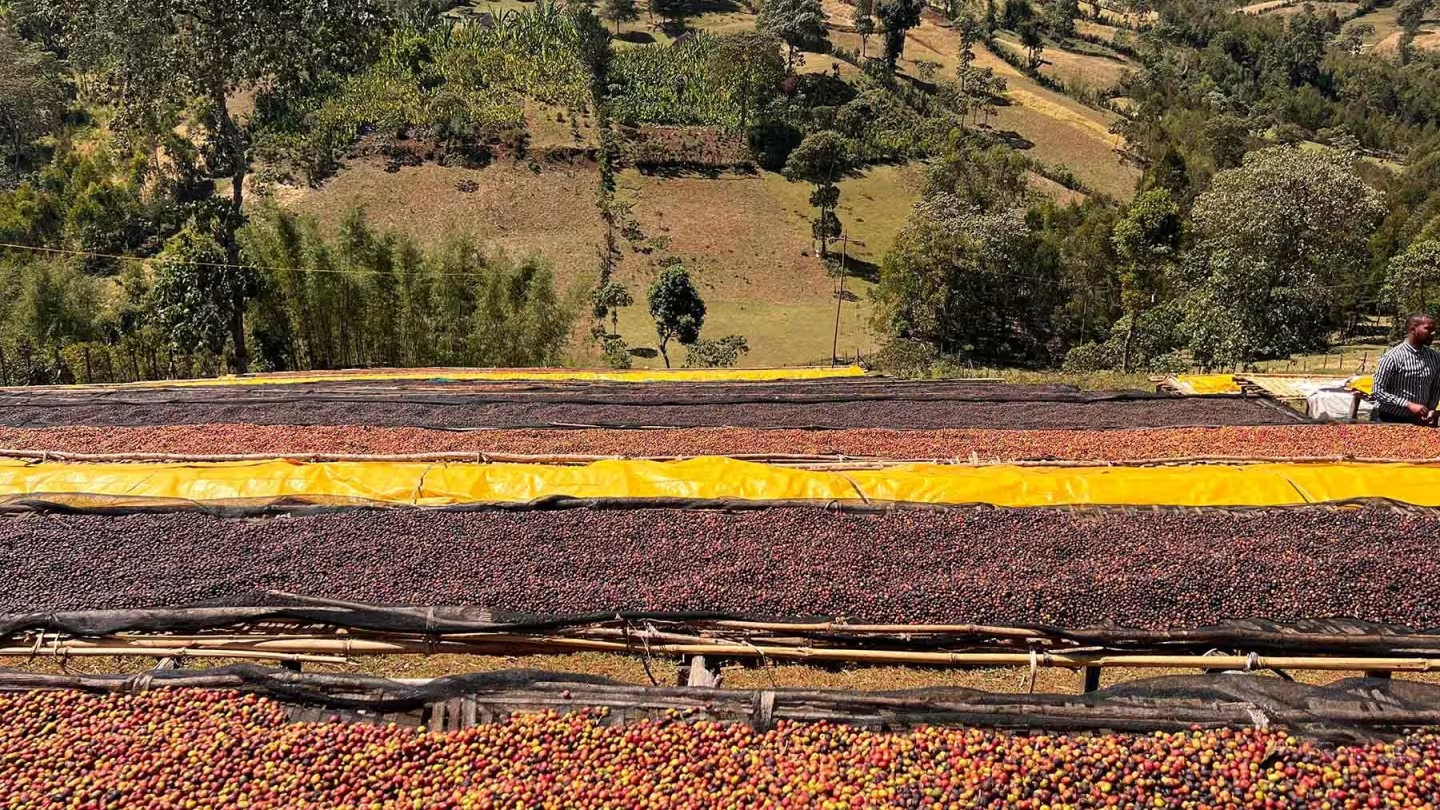
Ethiopia encompasses a wide diversity of ecosystems, including tropical and subtropical grasslands, savannas and shrublands, moist broadleaf forests, montane systems and arid landscapes. These ecosystems support biodiversity, rural livelihoods and climate resilience. Forest and land-use dynamics are closely linked to agricultural systems and rural energy needs, particularly coffee production, subsistence farming and the use of wood-based resources. Coffee is often grown under the shade of indigenous trees, integrating agricultural production with forest ecosystems. During the past seven years, the government’s Green Legacy Strategy has contributed to forest protection. Strengthened institutional coordination and enhanced stakeholder engagement are key to improving land and forest governance frameworks across the country.
Our approach
EFI works in Ethiopia to support sustainable and traceable agricultural commodity value chains, focusing on the coffee sector. Through tailored technical assistance, EFI promotes robust systems for traceability, legality assurance, and deforestation risk monitoring aligned with evolving international market requirements. Our work contributes to informed decision-making and resilient commodity systems.
In close collaboration with a range of national stakeholders including the Ethiopian Coffee and Tea Authority, the Ministry of Agriculture, the Space Science and Geospatial Institute, and Farm Africa, EFI’s work in Ethiopia is concentrated in several priority areas:
- Mapping to inform deforestation-free trade – supporting the development of a national coffee map, an updated national forest map, and the mapping of areas under participatory forest management.
- Traceability – strengthening the national coffee traceability system by improving site-level mapping and geolocation data, and supporting participatory forest management cooperatives to utilise the system to promote traceable forest coffee.
- Legality – developing methodologies and conducting coffee land-use audits in pilot areas, while supporting efforts to ensure that coffee plots are covered by valid land certifications.
Engagement – providing technical inputs and information support to the National Coffee Platform, fostering inclusive dialogue among public authorities, producers and cooperatives, civil society and private sector actors.
Projects in Ethiopia
Technical facility on deforestation-free value chains
We collaborate with commodity-producing countries to assist in transitioning to legal and deforestation-free value chains.
- Sustainable economy

Latest Ethiopia news
Collecting spatial data on coffee and forest cover in Ethiopia
Ethiopia Space Science and Geospatial Institute (SSGI) will collaborate with EFI to gather reference spatial data on coffee and forest cover.
- Inclusive governance
Latest Ethiopia publications
EU Deforestation Regulation: Early responses in producer countries
Early evidence shows how producer countries are adapting to the EU Deforestation Regulation through traceability, legal reviews, and coordination.
- Inclusive governance

Preparedness check of Ethiopia: coffee
This report explores EUDR systems, data gaps and recommendations to support Ethiopia’s coffee sector on traceability, legality and deforestation.
- Sustainable economy
