Forest context
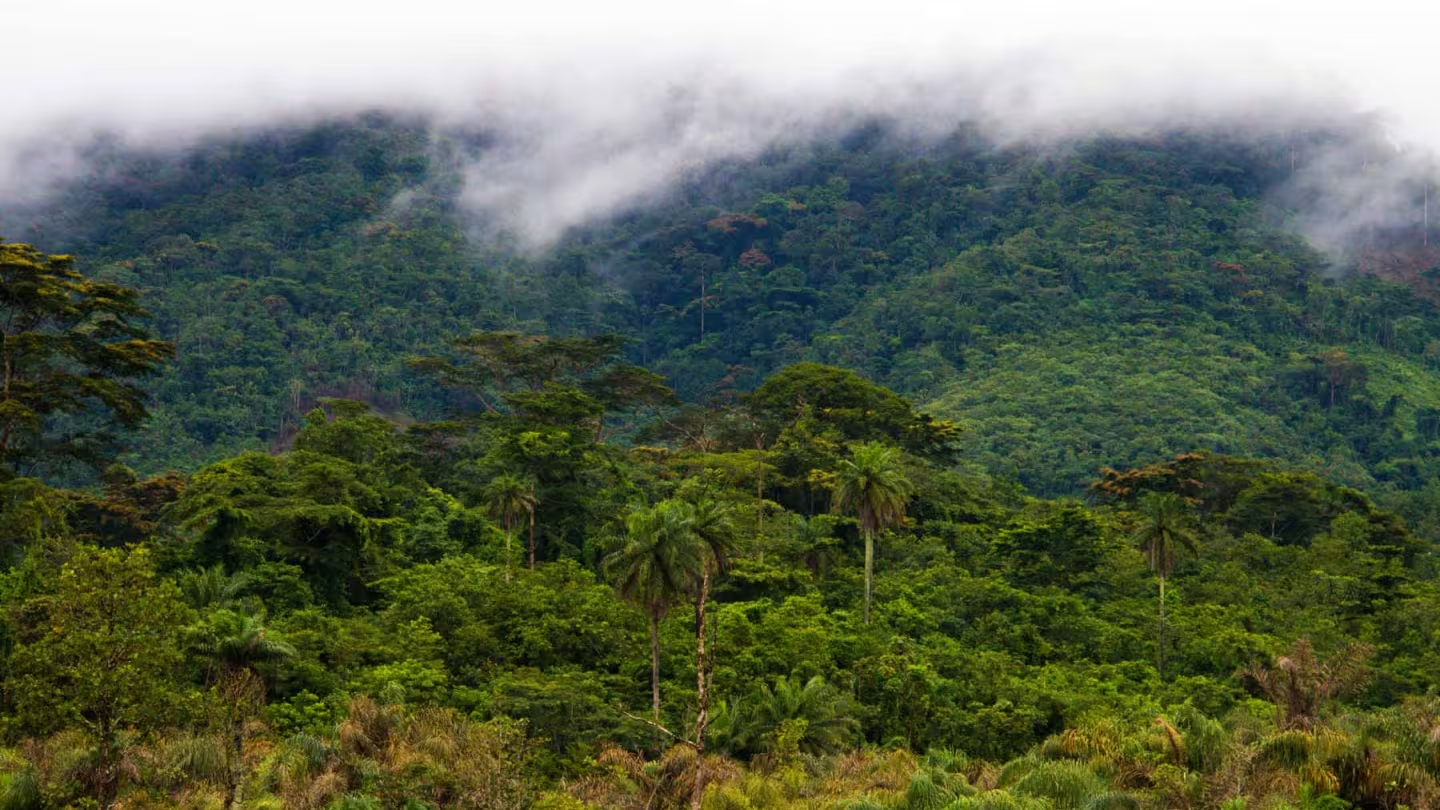
Liberia is home to some of West Africa’s most extensive tropical forests, accounting for more than two-thirds of the country’s total land area. These forests support biodiversity, help mitigate climate change, and are a primary source of economic livelihoods for rural communities. Liberia’s forests face pressures from deforestation caused by illegal logging, mining, and large-scale agricultural expansion for commodities such as cocoa. Approximately 260,000 hectares of primary forest were lost from 2002-2020. Liberia continues to implement forest governance reforms and strengthen its regulatory frameworks building on the foundations of the Forest Law Enforcement, Governance and Trade (FLEGT) Voluntary Partnership Agreement (VPA) between the European Union and Liberia. The government has made progress towards greater sustainable forest governance through an approach centred on ‘Four C’s’: community forestry, conservation, commercial forestry, and carbon and climate finance, offering a solid foundation for sustaining biodiversity, supporting rural livelihoods, and promoting sustainable development.
Our approach
EFI supports Liberia in advancing sustainable forest management and deforestation-free commodity value chains. Our approach is centred on technical assistance and inclusive engagement, supporting policy developments and specialised systems that enhance sustainable and legal forest and land use, and deforestation-free commodity production.
EFI collaborates with government agencies, local communities, civil society, and the private sector to foster transparent, accountable, and inclusive forest and land governance in the following sectors:
- Timber – strengthening institutional capacities and improving regulatory frameworks for forest governance and carbon markets; supporting the development and enhancement of tools and systems for timber legality and traceability; multi-stakeholder exchanges to learn from other countries’ experiences.
- Cocoa – supporting the deployment of tools to advance national traceability in the cocoa sector; facilitating multi-stakeholder dialogue and collaboration on sustainable cocoa production and reducing deforestation; building capacity to use data for informed land use management.
Projects in Liberia
EU FLEGT Facility
We supported the EU and timber-producing countries in the implementation of the FLEGT Action Plan with a focus on Voluntary Partnership Agreements.
- Inclusive governance
Latest Liberia publications
Preparedness check of Liberia: cocoa
This preparedness check assesses Liberia’s policies, tools and data supporting EUDR due diligence and cocoa supply chain compliance.
- Sustainable economy
