What role do forests play in the EU Nature Restoration Regulation?
The EU Nature Restoration Regulation (EU-NRR) officially came into force on 18 August 2024. Its enactment was preceded by a highly contested policymaking process, marked by close votes in the EU legislative institutions, numerous amendments and considerable public and media attention. The policy debate surrounding the legislative process of the EU-NRR attracted significant attention to forest ecosystems and an extensive mobilisation and influence of state and non-state forest policy actors (Fleckenstein et al. 2025). This was also because the European Commission (EC) exerted direct influence on forest policy and management in its Member States (MS) by formulating concrete, directly applicable and legally binding forest restoration targets and implementation timelines. In doing so, the EC attempted to move beyond voluntary biodiversity protection and conservation commitments, which have yielded unsatisfactory results, and to close the continuous regulatory gap for forest ecosystems at the EU level (EC 2022).
This development triggered strong reactions. Opponents of the bill, mainly center-right parliamentary groups and MS characterized by dominant agricultural and forestry sectors, forest and landowner associations, and representatives from other primary sector industries (see Figure 1), raised concerns about the potential impact of the forest restoration provisions in the EU-NRR on timber production, reinforced forest disturbance risks, and a lack of financial support for implementing forest restoration measures. On the other hand, supporters welcomed the establishment of forest ecosystem restoration indicators and targets at the EU level. They highlighted the potential of forest restoration measures to foster biodiversity and resilience, thereby ensuring the long-term viability of forest management (Fleckenstein et al. 2025).
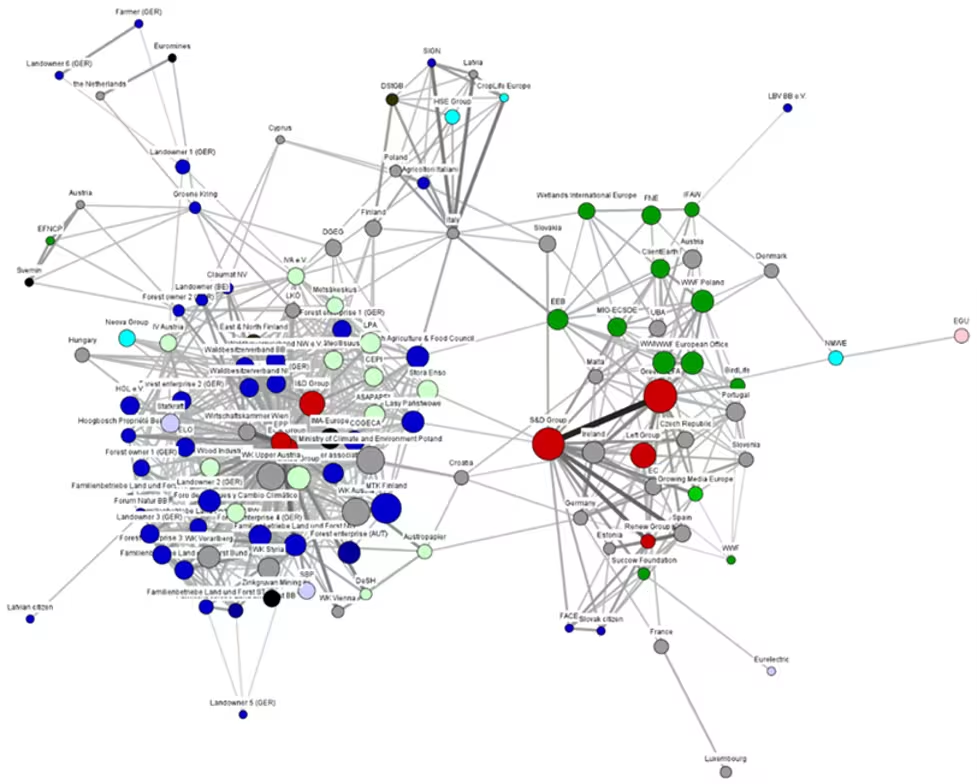
Figure 1. Strongly polarized political network that formed throughout the EU-NRR policy-making process. Nodes represent the actors that participated in the policy debate. Different node colors represent different organization types: grey: governmental bodies, blue: forest and landowner associations, dark green: ENGOs, mint green: forest industry associations, turquoise: business companies and associations, red: parliamentary groups, pink: scientific bodies, black: mining industry, pale violet: energy sector. Source: Fleckenstein et al. (2025).
What´s in the text?
The highly controversial and polarised policymaking process reached a resolution in June 2024, when the Environment Council granted final approval to the substantially revised bill. Despite strong opposition based on concerns over legislative competence and subsidiarity regarding the inclusion of forest ecosystems in the bill, the final adopted text assigns a central role to forest ecosystems through several articles (see Table 1).
| Article 4 Restoration of terrestrial, coastal and freshwater ecosystems |
| Article 4 stipulates the restoration of terrestrial, coastal, and freshwater habitats listed in Annex I of the EU Habitats Directive that are not in good condition, including protected forest habitat types. For these habitat types, restoration measures must be implemented by 2030 on at least 30% of the total area, by 2040 on at least 60%, and by 2050 on at least 90%. Initially, priority will be given to Natura 2000 areas. |
| Article 12 Restoration of forest ecosystems |
| Article 12 comprises the key provisions for forest ecosystems. It requires MS to implement restoration measures that enhance biodiversity in forest ecosystems. MS must demonstrate an increasing trend at the national level in the common forest bird index and in at least six out of seven of the following forest ecosystem restoration indicators: (a) standing deadwood; (b) lying deadwood; (c) the share of forests with uneven-aged structures; (d) forest connectivity; (e) the stock of organic carbon; (f) the share of forests dominated by native tree species; and (g) tree species diversity. These trends must be measured from the date of entry into force until December 31, 2030, and every six years thereafter. |
| Article 13 Planting three billion additional trees |
| Article 13 incorporates the EU Biodiversity Strategy's commitment to planting three billion trees by 2030 into the legal text, thus granting it legal status. |
The adoption of the EU-NRR marks a substantial change in EU environmental policy, especially in the realm of forest-related policy. Historically, the legal framework for forest policy at the EU level has been governed through forest-related policy areas, including environmental policy, agricultural policy renewable energy policy, trade and climate policy (Wolfslehner et al. 2020; Sotirov et al., 2021; Fleckenstein, 2024; Aggestam 2025). Until then, only strategic, non-legally binding forest policy instruments had emerged at the EU level (e.g., the EU Forest Strategy for 2030) (Aggestam, 2025; Pülzl et al., 2013; Basilicata et al., 2026). With the adoption of the EU-NRR and the introduction of concrete indicators and targets for forest ecosystem restoration, the EC exercises direct and legally binding influence over forest policy and management in Member States, marking a first in the history of EU policymaking. As a regulation, the EU-NRR is directly applicable and binding in its entirety, while allowing MS some flexibility to adapt its requirements to national conditions as they develop their national restoration plans.
What is needed for successful implementation?
The long-term success of the EU-NRR's forest ecosystem restoration provisions will critically depend on the close involvement of public and private forest owners and managers, the provision of sufficient funding and their compatibility with national forest institutions, including their policy and regulatory frameworks. An extensive analysis of the national forest legal frameworks of the 27 MS on key forest ecosystem indicators revealed a mixed picture: while some national forest acts set explicit goals and targets for certain forest restoration indicators and related management practices, others are only loosely addressed – or entirely absent – from the legal frameworks (see Figure 2).
As the EU-NRR moves from formulation to national implementation, the critical stance adopted by many forest and landowners and their associations during the legislative process continues to prevail. In the end, the success of the EU-NRR hinges on demonstrating the tangible benefits of forest restoration. This can only be achieved through constructive collaboration in the further development and implementation of national restoration plans, the first drafts of which were due to be submitted to the EC by the end of August 2026. From 2030 onwards, MS will be required to report every six years on their progress towards meeting the restoration targets and fulfilling their obligations to the EC, while approved national restoration plans will undergo review and revision in 2032 and 2042.
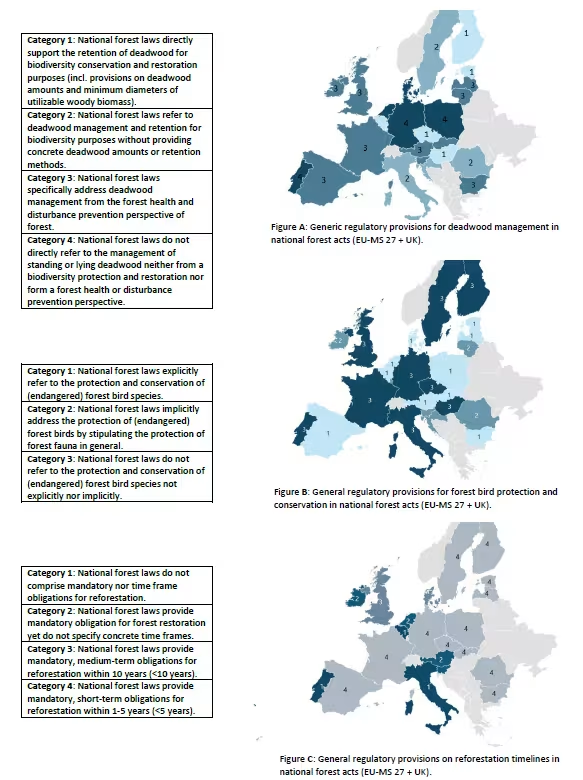
Figure 2. General regulatory provision on key forest ecosystem restoration indicators and practices (A: deadwood management, B: forest bird protection and conservation, C: reforestation) in the EU-MS 27 (based on Fleckenstein & Sotirov, 2024 and Sotirov et al., 2024).
References
Aggestam, F. (2025). European Forest Policy and Governance. An Integrative Analytical Framework. Routledge.
Basilicata, A., Pecurul-Botines, M., & Fleckenstein, S. (2026). The EU as a green normative power? Unpacking dynamics of norm diffusion in forest biodiversity politics. Policy Sciences, 59(2), 369-387. https://doi.org/10.1007/s11077-026-09610-2
European Commission (EC). (2022). Impact assessment accompanying the proposal for a Regulation of the European Parliament and of the Council on nature restoration (SWD(2022) 167 final). EUR-Lex - 52022SC0167 - EN - EUR-Lex
Fleckenstein, S., Sotirov, M. (2024). D5.1: European restoration policies map: Restoration policy and governance framework. Horizon 2020 Project No. 101036849, European Commission, 91 pp.
Fleckenstein, S., Schaub, S., & Sotirov, M. (2025). Forests in the spotlight: Discourse coalitions and storylines shaping the EU nature restoration regulation. Politics and Governance, 13. https://doi.org/10.17645/pag.10184
Fleckenstein, S. (2024). From sectoral policy change to cross-sectoral (dis) integration? A longitudinal analysis of the EU's forest and rural development policy. Forest Policy and Economics, 169, 103319. https://doi.org/10.1016/j.forpol.2024.103319
Pülzl, H., & Hogl, K. (2013). Forest governance in Europe. In: Pülzl, et al. (eds.) 2013. European forest governance: Issues at stake and the way forward. What Science Can Tell Us 2. European Forest Institute.
Sotirov, M., Winkel, G., & Eckerberg, K. (2021). The coalitional politics of the European Union’s environmental forest policy: Biodiversity conservation, timber legality, and climate protection. Ambio, 50(12), 2153-2167. https://doi.org/10.1007/s13280-021-01644-5
Sotirov, M., Malovrh, S, Jonsson, R. (2024). Chapter 3. Policy factors. In Carola Egger, Nelson Grima, Michael Kleine and Maja Radosavljevic (eds.). 2024. Europe’s wood supply in disruptive times. An evidence-based synthesis report. IUFRO World Series Volume 42. Vienna. 160 p.
Wolfslehner, B., Pülzl, H., Kleinschmit, D., Aggestam, F., Winkel, G., Candel, J., Eckerberg, K., Feindt, P., McDermott, C., Secco, L., Sotirov, M., Lackner, M., Roux, J.-L. 2020. European forest governance post-2020. From Science to Policy 10. European Forest Institute. https://doi.org/10.36333/fs10

Related content
When good forests look bad
A new peer-reviewed study examines how current EU conservation status assessment methods may distort the reported condition of forest habitats.
- Inclusive governance

How does EU decision-making work?
Losing sight of the wood for the trees? – EU decision-making explained
- Inclusive governance
From nature restoration to national restoration plans
This event discussed how to develop effective, realistic and socially accepted National Restoration Plans under the EU Nature Restoration Regulation.
4 November 2025, 10:00–11:30
- Inclusive governance