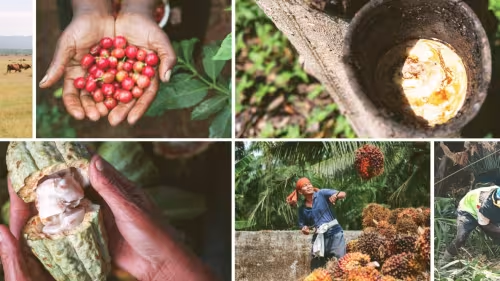
WHIMO: a practical tool for sharing traceability information across agricultural supply chains
Understanding where agricultural commodities come from, and how they move through supply chains, is increasingly important for companies, public institutions and other actors involved in trade and due diligence.
WHIMO — short for “What Is My Origin” — is an open-source app designed to help supply-chain actors record commodity transactions and exchange basic traceability information as goods move from origin to destination.
The tool focuses on a simple idea: when a commodity changes hands, relevant information should be able to move with it. In WHIMO, users record transactions such as purchases, collections, sales or deliveries. These records include basic details such as the commodity, volume, date and, where available, farm geolocation data.
WHIMO is designed for supply-chain actors such as cooperatives, local aggregators, transporters, processors, traders and exporters. Farmers are not required to use the app directly, although they may provide geolocation information, for example through a QR code. The tool is available in four languages: English, French, Spanish and Portuguese, and can be downloaded on Android and iOS devices.
WHIMO is particularly relevant in supply chains where information is fragmented, incomplete or held by different actors. The tool allows users to start recording transactions even when not all information is available. It also makes traceability gaps visible, helping users understand where information is complete, partial or missing.
WHIMO does not assess deforestation risk, evaluate legality or guarantee compliance with regulations. Its role is more specific: to support the collection, transfer and review of traceability data in a practical and consistent way. This information may then support broader due diligence processes, depending on users’ needs and responsibilities.
WHIMO includes mobile and web components. Transactions are recorded through the mobile app, while the web platform allows users to review data, explore basic analytics and download records for further use. The tool is open source, which means that institutions or organisations can also adapt the source code to develop their own version, depending on their context and data governance needs.
Additional tutorials are also available to guide users through specific steps, including how to record initial transactions, manage downstream transactions, share data and export information.
Related content
EUDR Community of Practice session in Barcelona explores legality due diligence in practice
The third EUDR CoP Core Group session brought together stakeholders to examine how legality due diligence can be approached in operational contexts.
- Inclusive governance
Technical facility on deforestation-free value chains
We collaborate with commodity-producing countries to assist in transitioning to legal and deforestation-free value chains.
- Sustainable economy
Community of Practice on the EUDR launched to support practical implementation across supply chains
A new public–private platform launched to support technical implementation and collaboration for the EUDR across global supply chains.
- Co-created solutions