
Photo by:
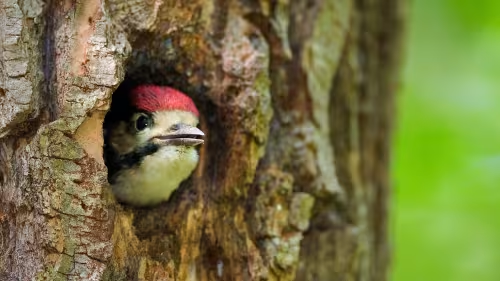
Photo by brummm / AdobeStock
Biodiversity is affected in opposing ways by increased disturbances due to climate change: natural disturbances like insect outbreaks and fires are increasing, making forests younger and more open. This benefits species that need light to grow, but harms those that depend on old and dense forests. Natural disturbances can also enhance biodiversity by creating chances to introduce (more) climate -adapted tree species.
Biodiversity matters, because
it is key to cope with disturbances: Forests with higher species and functional diversity are less likely to experience large-scale die-offs, as tree species respond differently to stress and disturbances.
Note ⇨ this effect is larger if you mix different species, such as slow- and fast-growing ones
it can stabilize productivity: Higher tree diversity can increase the safety and stability of forest production, making it a strategic asset for forest management for timber production.
Note ⇨ productivity may decrease with more slow-growing species
it is non-replaceable: Forest biodiversity is one of the hardest ecosystem services to substitute.
it provides holistic values: Biodiversity is highly valued and supports the adaptive capacity of forests, to ensure resilience for ecosystems and society.
What can policymakers and forest managers do to enhance biodiversity?
National and regional policymakers
Enhancing tree diversity:
- Promote tree species mixture with different functional traits to improve disturbance recovery and climate change adaptation. For example, combine broadleaved and coniferous species with different drought tolerance and disturbance susceptibility.
- Interlink the management of browsing by ungulates with the increase of tree diversity.
Promote structural diversity:
- Support the development of uneven-aged forests to reduce vulnerability and to speed up the recovery from disturbances.
- Encourage deadwood retention in the forest to enhance biodiversity and water and nutrient cycling.
- Incentivise advanced regeneration in forest stands to accelerate recovery after disturbance.
Provide financial support and training to forest managers:
- Employ training programmes on how to manage forests in ways that benefit biodiversity and increase resilience.
- Offer financial incentives to promote tree species and functional diversity and different aspects of structural complexity.
Forest owners and managers
Promote ecological and socio-economic resilience simultaneously:
- Diversify tree species composition to reduce the risk of large-scale losses during extreme weather events.
- Create forests with a mix of tree types and structures that support different species to sustain both biodiversity and timber production.
- Broaden business objectives to mitigate risks.
Use disturbances to spark biodiversity enhancement:
- Retain disturbance legacies, such as deadwood, advanced regeneration and surviving trees to support forest recovery and biodiversity and provide habitat for wildlife.
- Make use of novel silvicultural approaches that mimic disturbance dynamics.
Rethink management measures:
- Use locally adapted forest management practices.
- Designate set-aside areas with the potential to enhance their conservation value over time, serving as biodiversity stepping stones across the landscapes.
- Manage game density to foster natural regeneration of site adapted species.
What are the trade-offs?
Enhancing biodiversity affects timber production as introducing a higher tree diversity reduces short-term economic gains, but also builds long-term ecosystem stability and resilience. High-intensity management practices can mitigate certain disturbance impacts but often harm biodiversity and multifunctionality. Disturbance legacies may create deadwood benefiting biodiversity but may increase risks like pests or fires. Regional/local contexts matter, local conditions must dictate which measures (e.g., species choice, disturbance prevention) are feasible and effective, as uniform strategies increase the risk of failure. Using zoning across the landscape can help to balance priorities.
Reference
Lindner M., Kunstler, G., Seidl, R., Bredahl Jacobsen, J., Cantarello, E., Hlásny, T., Lloret, F., Patacca, M., Willig, J., Schifferdecker, G. 2025. Forest resilience and disturbance: What role does biodiversity play? Policy Brief 12. European Forest Institute. https://doi.org/10.36333/pb12
This Policy Brief had been written in collaboration with RESONATE: Resilient forest value chains – enhancing resilience through natural and socio-economic responses.



Related content
Comment pouvons-nous préserver et améliorer la biodiversité des forêts en Europe ?
Analyses scientifiques accessibles sur la biodiversité forestière, identifiant menaces clés et actions pour la gestion, les politiques et la finance.
- Resilient forests
Wie können wir die Biodiversität in den Wäldern Europas effektiv erhalten und verbessern?
Accessible science-based insights on forest biodiversity, outlining key threats and actions for management, policy and finance.
- Resilient forests
Come conservare e migliorare in modo adeguato la biodiversità delle foreste europee?
Analisi scientifiche accessibili sulla biodiversità forestale, con minacce chiave e azioni per gestione, politiche e finanza.
- Resilient forests