How bark beetles became a forest crisis?
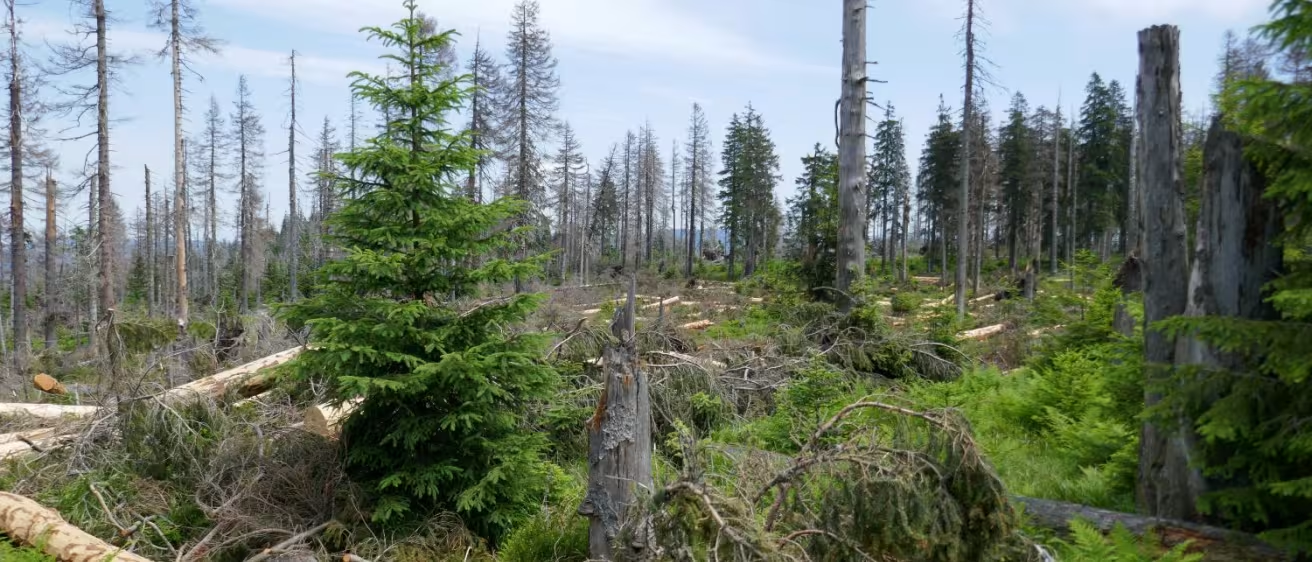
Few organisms provoke as much passion in forestry and policy debates as bark beetles. From Scandinavia to the Carpathians, images of dead conifers stretching to the horizon – and more often the bare ground left by salvage logging – have made these insects a symbol of forest crisis. Their outbreaks are now one of the most visible early signals of climate change reshaping European forests.
An ancient partnership
Most bark beetles – in Europe, most notoriously the European spruce bark beetle – are not invaders. They have coexisted with conifers for around 100 million years, and their coevolution has left deep marks on both sides. For example, trees evolved to produce defensive chemicals that kill or deter attacking beetles. In response, beetles evolved the ability to detoxify these compounds, coordinate mass attacks through pheromone signalling to overwhelm tree defences, and form partnerships with fungal associates that further support the attackers – depending on species, they may block the tree’s water transport, accelerate its decline, or improve the nutritional quality of the wood for developing larvae (Biedermann et al., 2019). This arms race has produced a balanced equilibrium, stable enough to have lasted for millions of years.
Bark beetles as ecological engineers
This coevolutionary dynamic extends from trees to ecosystems, where bark beetles play essential ecological roles. They kill weakened and ageing trees, and some species – particularly following windstorms – can erupt into outbreaks that reshape entire landscapes (Hlásny et al., 2019; 2021). The ecological consequences of these disturbances are far-reaching. Infestations initiate decomposition chains – involving fungi, bacteria, and other insects – that return nutrients to the soil and support entire food webs. Standing dead trees provide nesting and foraging habitat for birds and bats, while fallen logs shelter amphibians, small mammals, and a diversity of saproxylic insects. Canopy openings created by local outbreaks bring light to the forest floor, triggering regeneration and diversifying forest structures.
When do bark beetles become a problem?
So where does the current crisis come from? Across many regions of Europe, Norway spruce was planted for centuries far beyond its native montane and northern range. In hilly and lowland areas it grew fast, produced high-quality timber, and its silviculture became well established. However, extensive, often even-aged forests growing on ecologically unsuitable though productive sites offered bark beetles near-ideal conditions: an abundance of host trees and a lack of the diversity that buffers against disturbance. In such conditions, beetle populations could build to outbreak levels far more easily than in diverse forests at higher elevations and latitudes, where cooler temperatures limit their development and trees have sufficient water supplies to maintain their defences.
Climate change has further shifted conditions in the beetles’ favour. Warmer temperatures accelerate beetle development, enabling more generations per year and extending the flight season. Outbreak activity expands to higher elevations and latitudes, increasing risks in areas previously considered safe. More frequent and severe droughts reduce trees’ ability to produce the resin that is its primary defence, making otherwise healthy trees vulnerable. And when large-scale heat and drought events strike, outbreak activity synchronises across many countries (Hlásny et al., 2021; Das. et al., 2025). The clearest sign of a regime change is the recent emergence of large-scale outbreaks of the European spruce bark beetle triggered by drought alone – without the windstorms that historically served as the primary trigger (Das et al., 2025). As drought frequency and severity continue to increase, this shift carries far-reaching consequences for spruce forests and related economies across Europe.
Hence, the current crisis is best understood as the result of three factors converging: vulnerable forest structure and composition largely due to historical management, a climate that is changing faster than forests can adapt – either naturally or through management – and beetles that thrive in warmer conditions and exploit the opportunities this creates. Resolving this nexus requires not just controlling beetle populations through the familiar toolkit of salvage and sanitation logging, mass trapping, and insecticide spraying, but rethinking the forests we grow, and where and how we grow them.
References
Biedermann, P. H. W. et al. (2019). Bark beetle population dynamics in the Anthropocene: challenges and solutions. Trends in Ecology & Evolution, 34, 914–924. https://doi.org/10.1016/j.tree.2019.06.002
Das, A.K. et al. (2025). The increasing role of drought as an inciting factor of bark beetle outbreaks can cause large-scale transformation of Central European forests. Landscape Ecology, 40, 108. https://doi.org/10.1007/s10980-025-02125-w
Hlásny, T. et al. (2021). Bark beetle outbreaks in Europe: state of knowledge and ways forward for management. Current Forestry Reports, 7, 138–165. https://doi.org/10.1007/s40725-021-00142-x
Hlásny, T., et al. (2019). Living with bark beetles: impacts, outlook and management options. From Science to Policy 8. European Forest Institute. https://doi.org/10.36333/fs08

Related content
How to live with bark beetles in a warming climate?
Bark beetle outbreaks expose tensions between conservation, forest resilience, timber production and economic interests.
- Resilient forests
What is carbon farming in forests?
Explore carbon farming activities, practices and co-benefits
- Resilient forests
What is forest biodiversity?
Forest biodiversity includes not only species diversity, but also the variety of functions they perform, from genes to landscapes.
- Resilient forests