How to live with bark beetles in a warming climate?
Why bark beetles divide people
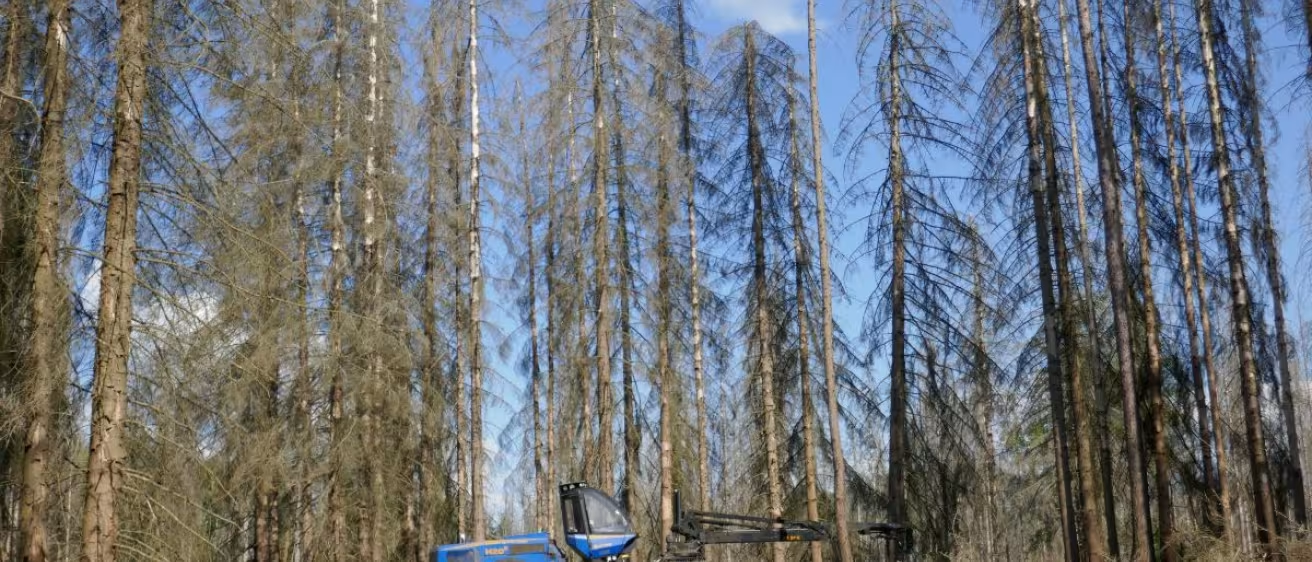
Bark beetle outbreaks have generated more societal conflict in Europe than almost any other forest disturbance or management issue – and for understandable reasons. In strictly protected areas such as national parks, non-intervention policy is grounded in the principle that disturbance is part of natural forest dynamics. Beetles kill trees and the forest renews itself – a process that underlies resilience and creates biodiversity-rich habitats. Yet this same process, witnessed by neighbouring landowners watching infestations spread or by communities whose familiar landscapes rapidly transform, generates legitimate concerns. Production forests present a different challenge. Here, bark beetles compete directly with humans for mature spruce trees, and the economic consequences can be severe: infestations compromise timber value, disrupt long-term management plans, and impose high costs for salvage operations and forest regeneration. These losses are often compounded by a market flooded with salvage timber, which drives down prices precisely when harvesting and regeneration costs are at their highest (Das et al., 2025).
Different forests – different responses
The two ends of Europe’s management spectrum are, in principle, relatively straightforward to address (Hlásny et al., 2019; 2025; Hlásny & Haas, 2023): in high-conservation-value forests, where biodiversity is the primary objective, natural disturbance dynamics and non-intervention should be respected; in strictly production-oriented forests, active disturbance suppression is a fully justified strategy, and it is the legal duty of managers across much of Europe to act against bark beetles. The real challenge lies between these two poles – on the varied ground of multifunctional forests, where production, biodiversity, recreation, water, and cultural values must all be considered.
There is no single solution that fits these complex conditions, but some general rules can be proposed (Hlásny et al., 2019; 2025; Hlásny & Haas, 2023). The first is landscape-scale zoning. Beetles should be actively contained in stands where timber value is high or public safety is at risk, while more natural dynamics are accepted where biodiversity matters more, wood quality and value are low, and forest owners are open to it. Such an approach is also practical in the face of outbreaks that affect whole countries and stretch harvesting capacity, transport and staff to their limits. Relocating resources, intervening where the most is at stake and stepping back where there is little chance of stopping the outbreak or saving much value, may be necessary and wise, delivering biodiversity gains as a side effect. Incentives that compensate owners for what they lose to beetles, and for the income they give up when intervention is deliberately withheld, are another vital part of the system. Combined with proper climate-adapted regeneration of disturbed sites, the emerging spatial heterogeneity may lay strong foundations for future resilience.
Such an approach also fits naturally with the European Commission’s Closer-to-Nature guidelines (European Commission, 2023; Stritih et al., 2025), which promote forests that combine timber, biodiversity, and carbon goals through native species, natural regeneration, structural diversity, and the retention of deadwood. An important contribution to this discussion has recently been made by a study of German forests, which found that the long-term disturbance rate (1986–2020) in forests set aside from management was, on average, 22% lower than in comparable managed forests (Krüger et al., 2025) – a strong argument for reconciling wood production and biodiversity in multifunctional forest landscapes.
Management strategy and a toolkit
Salvage and sanitary operations have been a cornerstone of bark beetle management in Europe, but they are only one element of a risk-management strategy capable of mitigating future outbreaks. Effective management means integrating a broader range of actions, such as silviculture and monitoring; optimized storage and transportation capacity; workforce development and training; spatial planning and zoning; and post-disturbance restoration that reduces future risk.
To support the development of national strategies, we proposed nearly forty measures – an outbreak-management toolkit – organised around the four phases of the Emergency Management Cycle: Preparedness, Prevention, Response, and Recovery (Biedermann et al., 2019; Hlásny et al., 2021; Hlásny & Haas, 2023). Organising the measures this way is more than a formality: it keeps this framework practical to apply, it is easier to communicate, and straightforward to tailor to different needs. Together with the overarching principle of social-ecological resilience, the framework can be adapted to the varied natural, cultural and legislative settings found across Europe.
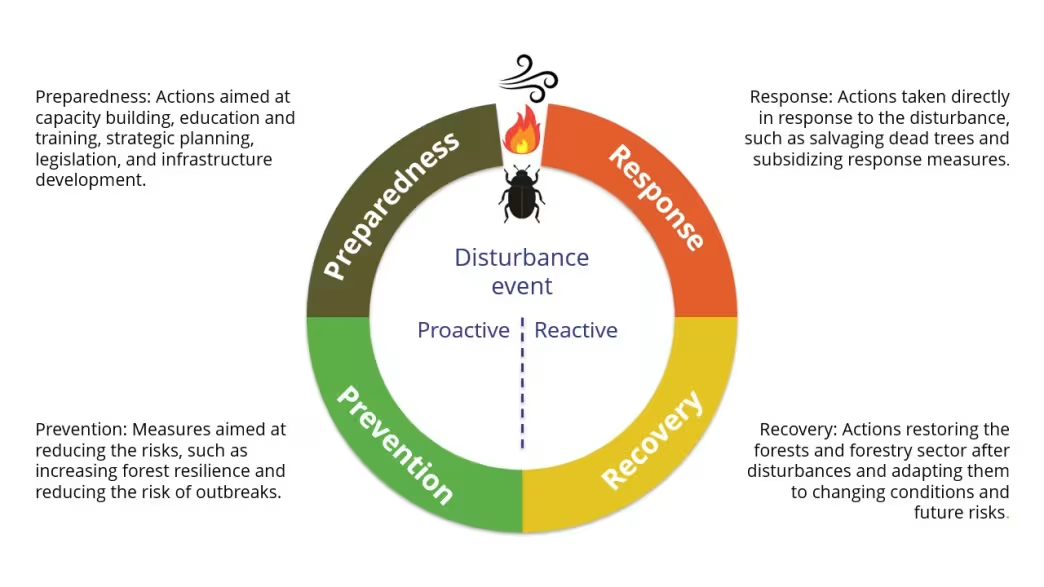
The four phases in the crisis management cycle for disaster risk reduction. Adapted from Hlásny & Haas (2023).
Shaping the next forest generation in a high-risk future
The most comprehensive projection yet made for Europe’s forests (Grünig et al., 2026) leaves little room for comfort: under every climate scenario, forest disturbance rises above the levels of recent decades, and under unabated warming it continues to increase throughout the 21st century. Many spruce forests will be lost in the coming decades, and continent-wide outbreak waves like the one that followed 2018 will, with high confidence, recur. Despite our advances in monitoring, genomics and chemical ecology, there is no magic wand that can rescue a forestry built on coniferous monocultures under climate change.
What matters now is the shape of the forest generation to come. Forests grown as mixtures of climate-adapted – mostly broadleaved – species have proved less vulnerable, better able to absorb disturbance and recover from it. In many regions regeneration must be actively steered in that direction, or the legacy of past stands and poor management practices will produce another vulnerable generation. Combined with spatial heterogeneity and biodiversity – both of which proper disturbance management can promote – they offer a real buffer against future disturbance. Seen this way, bark beetles are not only a destructive force but a force of change and adaptation that management can put to use.
References
Biedermann, P. H. W. et al. (2019). Bark beetle population dynamics in the Anthropocene: challenges and solutions. Trends in Ecology & Evolution, 34, 914–924. https://doi.org/10.1016/j.tree.2019.06.002
Das, A.K. et al. (2025). The increasing role of drought as an inciting factor of bark beetle outbreaks can cause large-scale transformation of Central European forests. Landscape Ecology, 40, 108. https://doi.org/10.1007/s10980-025-02125-w
European Commission (2023). Commission Staff Working Document: Guidelines on Closer-to-Nature Forest Management, Brussels.
Grünig, M. et al. (2026). Climate change will increase forest disturbances in Europe throughout the 21st century. Science, 391, eadx6329. https://doi.org/10.1126/science.adx6329
Hlásny, T. et al. (2025) Diverging trends in insect disturbance across Europe`s temperate and boreal Forests. Global Change Biology 31, 11 e70580. https://doi.org/10.1111/gcb.70580
Hlásny, T. et al. (2021). Bark beetle outbreaks in Europe: state of knowledge and ways forward for management. Current Forestry Reports, 7, 138–165. https://doi.org/10.1007/s40725-021-00142-x
Hlásny, T., et al. (2019). Living with bark beetles: impacts, outlook and management options. From Science to Policy 8. European Forest Institute. https://doi.org/10.36333/fs08

Related content
How bark beetles became a forest crisis?
Bark beetle outbreaks have become a powerful symbol of forest crisis and a visible sign of climate change reshaping Europe’s forests.
- Resilient forests
What is carbon farming in forests?
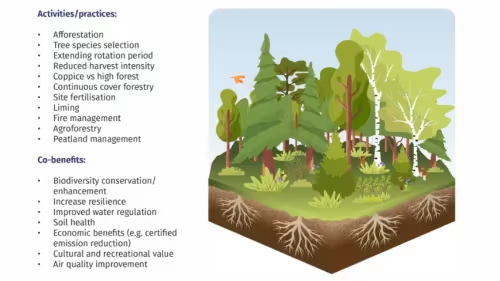
Explore carbon farming activities, practices and co-benefits
- Resilient forests
What is forest biodiversity?
Forest biodiversity includes not only species diversity, but also the variety of functions they perform, from genes to landscapes.
- Resilient forests