How can carbon farming in forests contribute to carbon neutrality?
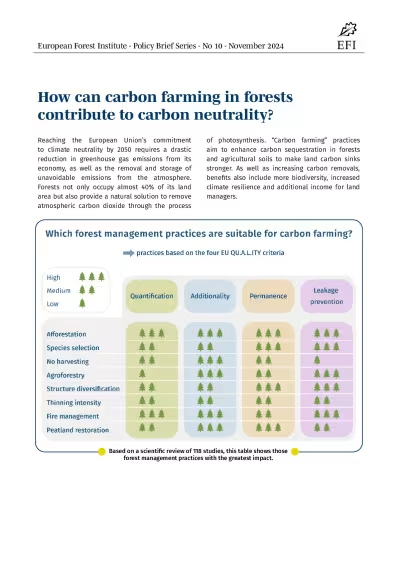

Photo by:
Miha Creative, Adobe Stock
Reaching the European Union’s commitment to climate neutrality by 2050 requires a drastic reduction in greenhouse gas emissions from its economy, as well as the removal and storage of unavoidable emissions from the atmosphere. Forests not only occupy almost 40% of its land area but also provide a natural solution to remove atmospheric carbon dioxide through the process of photosynthesis. “Carbon farming” practices aim to enhance carbon sequestration in forests and agricultural soils to make land carbon sinks stronger. As well as increasing carbon removals, benefits also include more biodiversity, increased climate resilience and additional income for land managers.
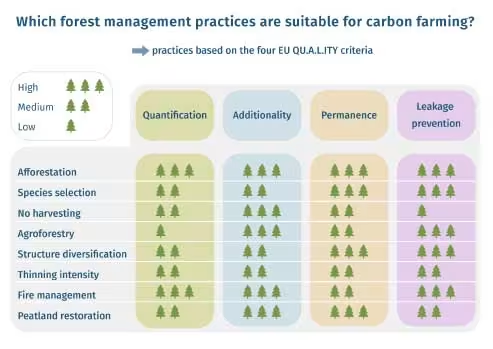
Based on a scientific review of 118 studies, this table shows those forest management practices with the greatest impact.
What are the challenges for carbon farming in forests?
Balancing climate goals with forest resilience: The need to increase the net forest carbon sink (short-term) is challenged by the need to increase forest resilience and stability (longterm).
Non-permanence of forest carbon storage: Sequestered carbon can be released back into the atmosphere in the future due to harvesting and disturbances.
Setting baselines and verifying carbon removals and gains resulting from various land management measures presents important challenges due to high variability in biophysical conditions and previous management practices across Europe.
Additionality requires “proof” of lower carbon sequestration or higher soil emissions in the absence of carbon farming measures.
The need to deliver multiple environmental co-benefits simultaneously with carbon sequestration: biodiversity conservation, water regulation, or soil health improvement are important among other ecosystem services.
Methodological (quantification) problems: changes in soil carbon are difficult to measure and quantify, and there is a need for method harmonisation and improvement. Measuring carbon sequestration in above-ground forest biomass is less demanding and cost intensive than measuring/modelling carbon sequestration in forest soils. It is also important to define the exact scope of carbon farming projects.
What can policymakers do?
Uncover conflicting policy goals and resolve them to support carbon farming in forests (e.g. national schemes for payments for ecosystem services provide funding for lowering wood harvest, while the EU Renewable Energy Directive promotes the use of biomass for bioenergy).
Make activities funded by voluntary carbon markets visible in the country’s national greenhouse gas inventory to avoid double-counting.
Increase the attractiveness of credits from carbon farming in forestry. Instead of just using credits to offset greenhouse gas emissions, alternative uses could include compliance use of units for contribution claims, or for getting access to subsidy schemes.
In cases of high uncertainty, approaches should be more conservative. It is important to determine removals conservatively, rather than using the most accurate estimates.
Reference
Chiti, T., Rey, A., Abildtrup, J., Böttcher, H., Diaci, J., Frings, O., Lehtonen, A., Schindlbacher, A., Zavala, M. A. 2024. How can carbon farming in forests contribute to carbon neutrality? Policy Brief 10. European Forest Institute. https://doi.org/10.36333/pb10

Related content
Come può il carbon farming nel settore forestale contribuire alla neutralità carbonica?
Sfide per il carbon farming nelle foreste e proposte per i decisori politici
- Resilient forests

- Resilient forests

The Role of Biodiversity in Making Forests Resilient
Key results of RESONATE project.
- Resilient forests