How to strengthen the European forest carbon sink through prestoration: integrating active restoration and adaptation
Photo by:
Photo by Cavan / AdobeStock
Climate change-induced stress and disturbances threaten European forests’ biodiversity and ecosystem services. Today, climate change is advancing much faster than tree species can adapt to new conditions or migrate to regions with a suitable climate. Geographic barriers and land-use driven habitat fragmentation slow down natural dispersal and adaptation processes or make them ineffective, and thus further limit passive restoration (restoration with no or limited human interference).
According to latest scientific evidence, the annual forest carbon sink of Europe is projected to decline by about 30–40% by 2061–2080, depending on the climate change scenario, if forest restoration only uses local tree populations, as some of them become climatically maladapted (see Chakraborty et al. 2024).
Active forest restoration combined with assisted migration (prestoration), i.e. using always the climatically most suitable European tree species and populations, has the long-term potential to enhance carbon sequestration significantly compared to restoration efforts without assisted migration.
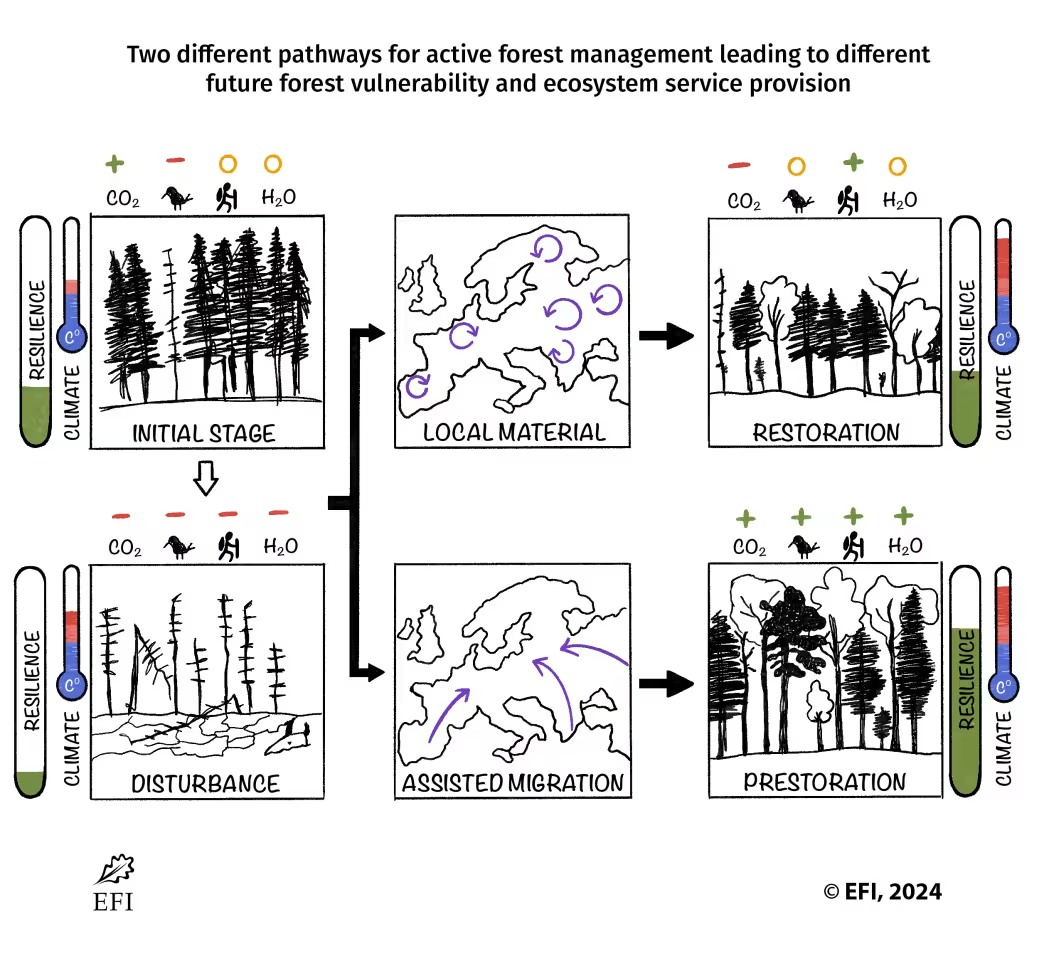
Two different pathways for active forest management leading to different future forest vulnerability and ecosystem service provision.
Assisted migration, which means aligning tree species and populations to the climate to which they are adapted, comes in three forms:
- Assisted population migration, also known as assisted genetic migration or gene flow, refers to moving populations (= seed sources/ provenances) to new locations within the historical species range.
- Assisted range expansion refers to moving species or populations from their current range to suitable areas just beyond the historical species range, facilitating or mimicking natural dispersal that would otherwise occur over centuries.
- Assisted species migration or assisted long[1]distance migration involves moving species or populations to a location far outside the historical species range, where they could not arrive through natural processes or only over millennia.
What can policy makers do for an effective implementation and future adjustments of the EU Nature Restoration Legislation (NRL)?
- Use a strategic blend of passive and active restoration measures to secure the natural dynamics and multifunctionality of European forests as climate impact and societal demands change quickly and dispersal barriers persist.
- Understand assisted tree species migration as an essential risk mitigation measure as it provides more options to increase forests’ adaptative capacity and improve resilience, biodiversity and provisioning of ecosystem services including carbon sequestration.
- Identify and conserve local genetic material to enable assisted migration at European scale in line with activities of European Forest Genetic Resources Programme (EUFORGEN).
- Redefine the concept of European native tree species based on their potential future ranges in line with Europe’s long history of intentional species translocation. This means moving beyond the current definition in the NRL, which focuses solely on tree’s natural dispersal potential.
- Set realistic restoration targets that can be achieved despite ongoing climate change, and pro-actively tackle adaptation also within the Natura 2000 system. Otherwise, a common excuse for non-fulfillment of the NRL will be ‘unavoidable habitat transformations which are directly caused by climate change‘ (compare Articles 4.14.b and 12.4.b).
Reference
Chakraborty, D., Schüler S., Ciceu, A. , Bauhus, J., Bou Dagher, M. , Đodan, M., Kramer, K. , Svensson, J., Schatzdorfer, E. 2024. How to strengthen the European forest carbon sink through prestoration: integrating active restoration and adaptation. Policy Brief 11. European Forest Institute. https://doi.org/10.36333/pb11
Further reading: Chakraborty et al. 2024. https://doi. org/10.1038/s41558-024-02080-5
-
Debojyoti Chakraborty

Silvio Schüler
Albert Ciceu
Martina Đodan
Koen Kramer
Johan Svensson

Related content
Seeing the forest clearly
Join the discussion on Europe’s primary and old-growth forests and how accurate mapping can help protect them.
26 November 2026, 10:00–11:30
- Resilient forests
Voices of the Mediterranean Forests: apply now for a media workshop on Forest Genetic Resources
Apply by 15 August for a fully funded media workshop on Forest Genetic Resources in Barcelona, 30 November to 2 December 2026.
- Resilient forests

Dynamic and static ex situ conservation: minimum requirements, data standards and indicators for monitoring
EUFORGEN report clarifies terminology, sets minimum requirements and standards, and guides dynamic ex situ FGR conservation.
- Resilient forests