Mapping the EU’s forest policy objectives
From multifunctionality to forests in a circular bioeconomy
Photo by:
Marharyta/ AdobeStock
EU forest governance is dispersed across numerous legal and non-legal instruments, with objectives formulated in different sectors and driven by different European Commission Directorates-General. Understanding how these objectives have evolved and how they relate to one another is essential to designing policies that are both effective and forward-looking.
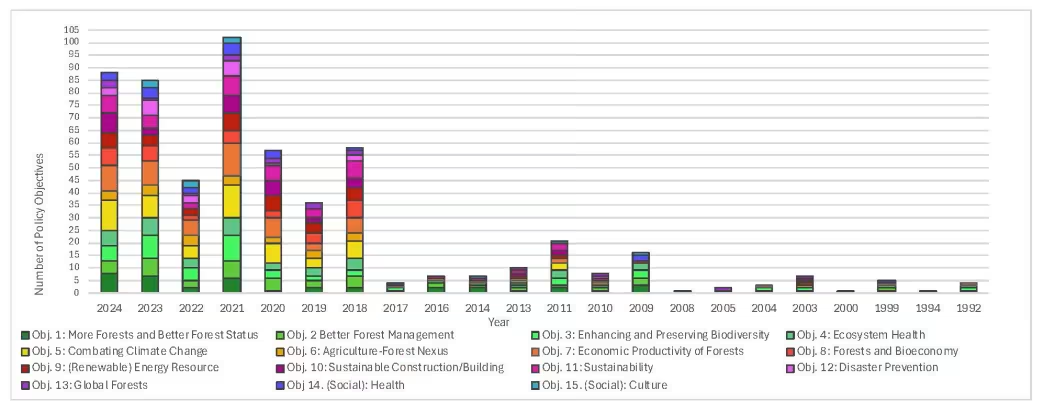
Graph from Policy Brief 18, credit EFI
EU forest objectives are shifting (1992-2024)
- Rapidly expanding and more ambitious agenda, including combating climate change Forest-related objectives grew 2.5 times in 2019–2024 compared to 1992- 2018, driven by the Green Deal and a growing acknowledgment of forests’ multifunctionality—from carbon storage and biodiversity to renewable materials, energy, risk reduction, health, and rural development. Combating climate change is fully mainstreamed across instruments.
- Growing convergence of climate, biodiversity, and productivity goals While potentially conflicting, these goals are increasingly framed as compatible. Recent policies promote circularity, cascading use of biomass, and climate-smart forestry as near “silver bullet” solutions linking environmental priorities with innovation, income, and wider societal benefits.
- Economic productivity remains central Policies often present environmental ambition as boosting competitiveness, efficiency, and new revenue tied to forest ecosystem services—showing a long-running integration of ecological and economic aims, with shifting emphasis across political cycles.
- Objectives spread evenly across legal and non-legal tools Binding instruments tend to regulate biodiversity, plant health, and standards, while non-binding ones outline integrated visions connecting resilience and economic modernisation—illustrating the breadth and complexity of EU forest governance.
- Institutional diversity challenges coherence Different sectors shape forest objectives through varied tools—regulations, guidance, funding, certification, market standards— creating fragmentation where objectives can align or conflict.
- Social and cultural values remain marginal Despite recognised benefits for health, recreation, and culture, these dimensions still receive far less attention than climate, biodiversity, and economic goals.
What policymakers should consider
- Strengthen cross-sector coherence through better cross-DG coordination Create a structured mechanism to align circularity, climate mitigation and bioeconomy development across Commission portfolios, supported by a shared registry of objectives, overlaps and contradictions.
- Support practical tools for managing multifunctionality Translate forest multifunctionality into concrete planning tools, including explicit trade-off analysis across climate, biodiversity, energy and industrial uses.
- Address multi-level governance challenges Effective implementation depends on Member State contexts. Future policies should better account for national differences in forest conditions, policy styles and societal priorities and develop support tools that help Member States apply forest objectives consistently across differing economic, ecological and social contexts, in particular as the EU prepares for enlargement.
- Align research and data with multifunctionality needs Further strengthen harmonised datasets and models that can assess simultaneous progress towards multiple forest objectives.
- Strengthen public awareness of forest complexity Support initiatives that highlight forests’ multiple roles to foster a broader public and political understanding of their contributions, needs and limits.
Reference
Wydra, D., Pülzl, H., Matrone, A. 2025. Mapping the EU’s forest policy objectives: From multifunctionality to forests in a circular bioeconomy. EFI Policy Brief 18. European Forest Institute. https://doi.org/10.36333/pb18
Note: This work was financially supported by EFI’s Multi-Donor Trust Fund for policy support, which is supported by the governments of Austria, Czech Republic, Finland, Germany, Ireland, Italy, Lithuania, Norway, Slovenia and Spain.
-

Alessandro Matrone

Related content
3 x 3 x 2030: Nine priorities for implementing the EU’s Forest Strategy
A review of EU Forest Strategy implementation across 15 countries with nine proposed priorities to balance climate, biodiversity and economy.
- Inclusive governance

- Inclusive governance

European forest governance post-2020
This 2020 report reviews significant developments in the forest governance framework including EU and international developments.
- Inclusive governance