Research Agenda – Biocities of the future
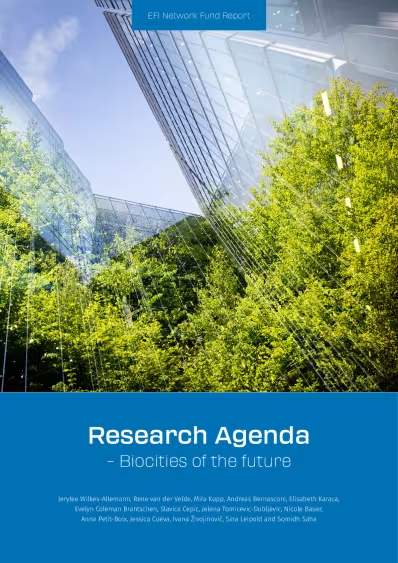
In 2022, EFI launched the Biocities Facility to better connect science-based knowledge to policy and practice, and to unlock the potential of forest-based solutions in rethinking and co-creating sustainable, healthy and resilient cities, while leading the decarbonization of our society.
In support of the Facility the ReBio project was funded to develop a Biocities Research Agenda, which has identified knowledge gaps and specific topics and activities that could be addressed by the new Facility.
The overall objective of the Research Agenda is to contribute towards transforming existing cities to Biocities and provide a framework for new urban developments.
Five key topic areas were identified as a framework for elaboration of a research agenda to facilitate the transition to Biocities: (1) circular bioeconomy, (2) climate resilience, (3) governance, (4) social and human environment, and (5) biodiversity. Various challenges arise from different perspectives in these topic areas, such as life-cycle management, cultural change, prioritisation of sustainable approaches, urban carbon storage, infrastructural adaptation, bioresilience, participation, cross-sectoral planning, systemic integration of health and wellbeing, and spatial sustainability.
The implementation of the Research Agenda will require five pathways: (i) an international coordinated research effort, (ii) interdisciplinary networks, (iii) integration of other initiatives, (iv) conceptual capacity building and (v) support for emerging disciplines. The implementation of the Research Agenda is expected to contribute to the Sustainable Development Goals in an urban context, as well as to support the Green Deal Strategy of the European Commission and the promotion of One Health.
Consortium
ReBio was a collaborative work of an interdisciplinary group of experts and scientists from the following organisations:
- Bern University of Applied Sciences (BFH), School of Agricultural, Forest and Food Sciences (HAFL),
- University of Natural Resources and Life Sciences (BOKU), Institute of Forest, Environmental and Natural Resource Policy
- University of Freiburg, Faculty of Environment and Natural Resources
- Karlsruhe Institute of Technology (KIT), Institute for Technology Assessment and Systems Analysis (ITAS)
- Delft University of Technology, Faculty of Architecture and the Built Environment, Research Fellowship Urban Forestry
- University of Belgrade, Faculty of Forestry, Department of Landscape Architecture and Horticulture
- Swiss Federal Institute for Forest, Snow and Landscape Research WSL
- Pan Bern AG
Citation
Wilkes-Allemann, J., van der Velde, R., Kopp, M., Bernasconi, A., Karaca, E., Coleman Brantschen, E., Cepic, S., Tomicevic-Dubljevic, J., Bauer, N., Petit-Boix, A., Cueva, J., Živojinović, I., Leipold, S. and Saha, S. 2022. Research Agenda – Biocities of the future. European Forest Institute. https://doi.org/10.36333/rs4
Number of pages: 48
ISBN 978-952-7426-29-6 (pdf)

Related content
How can trees and forests support sustainable and climate friendly cities?
Forests and trees support climate-smart cities through renewable bio-based products and ecosystem services that boost resilience and well-being.
- Cities

Nature as cities' cooling infrastructure: EFI Biocities webinar explores urban forests for climate adaptation
Experts at EFI Biocities' second webinar shared how urban forests and nature-based solutions can help cities adapt to extreme heat.
- Cities

EFI Biocities webinar: Urban forests for climate change adaptation
Urban heat is rising, and green infrastructure is part of the answer. Explore how at the next EFI Biocities webinar on 30 September.
30 September 2026, 17:00–18:30
- Cities