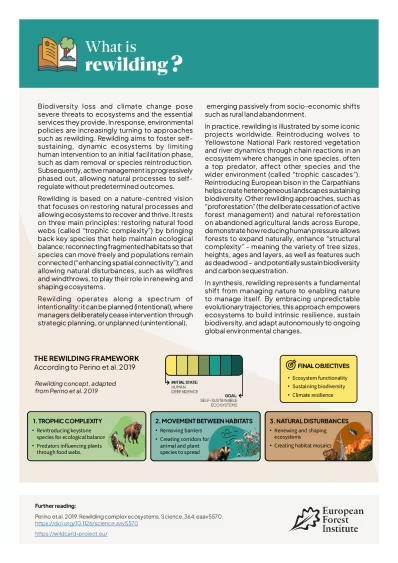
Biodiversity loss and climate change pose severe threats to ecosystems and the essential services they provide. In response, environmental policies are increasingly turning to approaches such as rewilding. Rewilding aims to foster selfsustaining, dynamic ecosystems by limiting human intervention to an initial facilitation phase, such as dam removal or species reintroduction. Subsequently, active management is progressively phased out, allowing natural processes to selfregulate without predetermined outcomes.
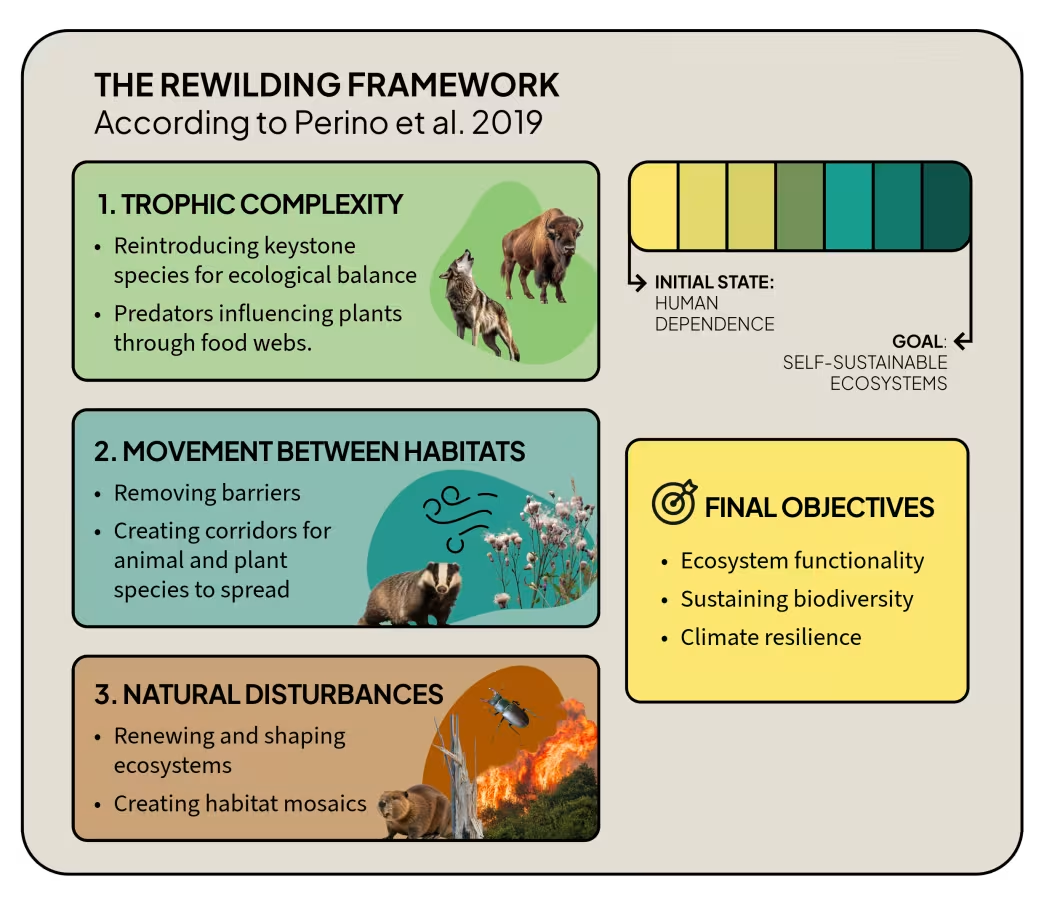
Rewilding is based on a nature-centred vision that focuses on restoring natural processes and allowing ecosystems to recover and thrive. It rests on three main principles: restoring natural food webs (called “trophic complexity”) by bringing back key species that help maintain ecological balance; reconnecting fragmented habitats so that species can move freely and populations remain connected (“enhancing spatial connectivity”); and allowing natural disturbances, such as wildfires and windthrows, to play their role in renewing and shaping ecosystems.
Rewilding operates along a spectrum of intentionality: it can be planned (intentional), where managers deliberately cease intervention through strategic planning, or unplanned (unintentional), emerging passively from socio-economic shifts such as rural land abandonment.
In practice, rewilding is illustrated by some iconic projects worldwide. Reintroducing wolves to Yellowstone National Park restored vegetation and river dynamics through chain reactions in an ecosystem where changes in one species, often a top predator, affect other species and the wider environment (called “trophic cascades”). Reintroducing European bison in the Carpathians helps create heterogeneous landscapes sustaining biodiversity. Other rewilding approaches, such as “proforestation” (the deliberate cessation of active forest management) and natural reforestation on abandoned agricultural lands across Europe, demonstrate how reducing human pressure allows forests to expand naturally, enhance “structural complexity” - meaning the variety of tree sizes, heights, ages and layers, as well as features such as deadwood – and potentially sustain biodiversity and carbon sequestration.
In synthesis, rewilding represents a fundamental shift from managing nature to enabling nature to manage itself. By embracing unpredictable evolutionary trajectories, this approach empowers ecosystems to build intrinsic resilience, sustain biodiversity, and adapt autonomously to ongoing global environmental changes.
Further reading
Perino et al. 2019. Rewilding complex ecosystems. Science, 364: eaav5570. https://doi.org/10.1126/science.aav5570

Related content
- Resilient forests

- Resilient forests

What are the key steps for planning biodiversity monitoring in forest restoration?
Structured monitoring is essential not only to demonstrate restoration success but to guide and improve ongoing efforts.
- Resilient forests