Mapping Lebanon’s hidden insect world, one barcode at a time
Lebanon is a country of striking ecological contrasts. Despite its small size (10,452 km²), it supports an estimated 9,000 species, nearly 0.8% of global biodiversity, owing to its unique position between three continents, its rugged mountains, and pronounced climatic gradients. Yet for all its richness, Lebanon’s insect diversity has remained largely uncharted territory, tucked away in outdated checklists and scattered museum drawers.
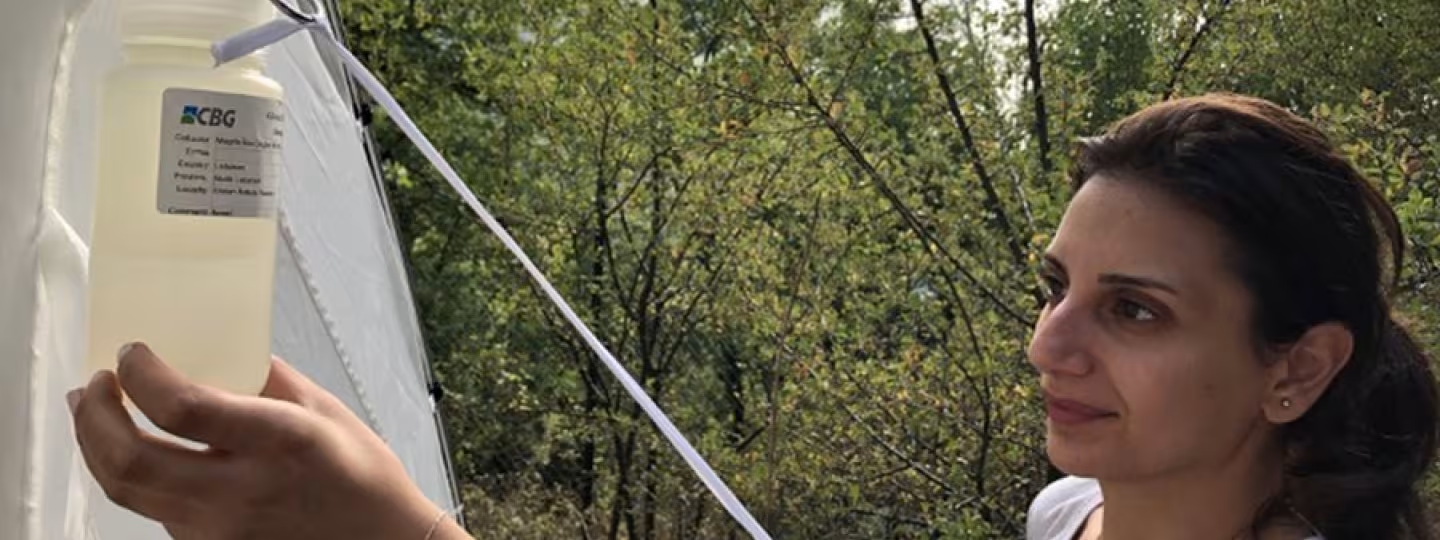
A new study published in Genome sets out to change that. At the Biodiversity and Functional Genomics Laboratory, of the Faculty of Sciences at Saint Joseph University of Beirut, Prof. Bou Dagher Kharrat’s team advanced insect biodiversity knowledge by deploying Malaise traps at four sites across Lebanon’s main biogeographical regions between 2019 and 2021. This effort resulted in the country’s first comprehensive DNA barcode library for insects, a molecular fingerprint catalogue enabling rapid and accurate species identification, often beyond the limits of morphology alone.
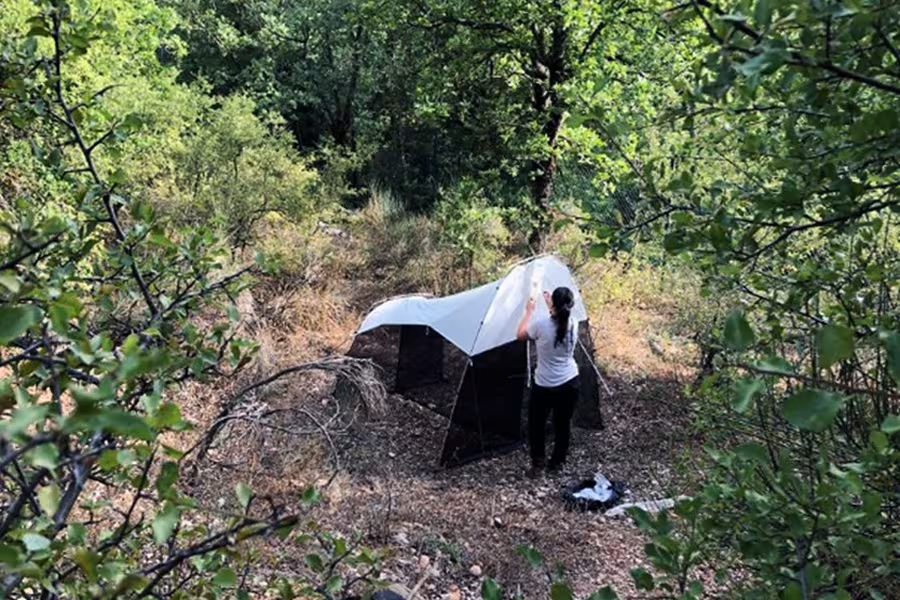
Installation of a malaise trap – a tent-like structure made of fine mesh used to passively capture flying insects. Insects flying into it are guided upward into a collecting jar filled with alcohol at the highest point.
Photo by:
Magda Bou Dagher Kharrat, EFI
What the barcodes revealed
The numbers are striking. Of the 5,747 Barcode Index Numbers (BINs) (genetic units that closely correspond to biological species) identified from the survey, 56% had never been recorded anywhere else in the global reference database. That proportion of uniqueness points to high levels of endemism, not just within Lebanon but across the broader Levant region, whose insect fauna remains critically under-documented.
Across the 58,123 specimens, researchers assigned identities to 1,224 species spanning 20 insect orders. The five most abundant orders accounted for 95% of all specimens: Diptera (flies), Hymenoptera (bees, wasps, ants), Hemiptera (bugs), Coleoptera (beetles), and Lepidoptera (moths and butterflies).
This work builds on Lebanon’s earlier steps into molecular biodiversity science. After joining the International Barcode of Life (iBOL) in 2018, the team established DNA reference libraries for Eastern Mediterranean plants and mammals. The new insect dataset substantially expands Lebanon’s footprint in the global Barcode of Life Data System (BOLD).
58,123
Insect specimens analysed
5,747
Genetic species units (BINs) identified
56
%of BINs unique to the Eastern Mediterranean
Why it matters for the Mediterranean forest
Insects are the connective tissue of forest ecosystems (pollinators, decomposers, prey for birds and bats, agents of nutrient cycling). Understanding which species are present, where they occur, and how assemblages shift with elevation and land-use change is foundational to any credible monitoring or conservation programme. Lebanon’s steep topography, which compresses multiple climate zones into short distances, makes it a natural laboratory for studying how insects respond to environmental gradients, and how those responses may accelerate under climate change.
The new barcode library makes this monitoring possible at scale. Paired with metabarcoding and environmental DNA (eDNA) tools, it enables rapid, non-invasive assessments of whole insect communities from bulk trap samples or even water and soil, a gamechanger for long-term ecological surveillance across the Eastern Mediterranean.
Beyond pure science, the applications are practical. Better insect identification supports targeted management of agricultural pests and disease vectors, critical concerns in a region where food security and public health are increasingly under pressure.
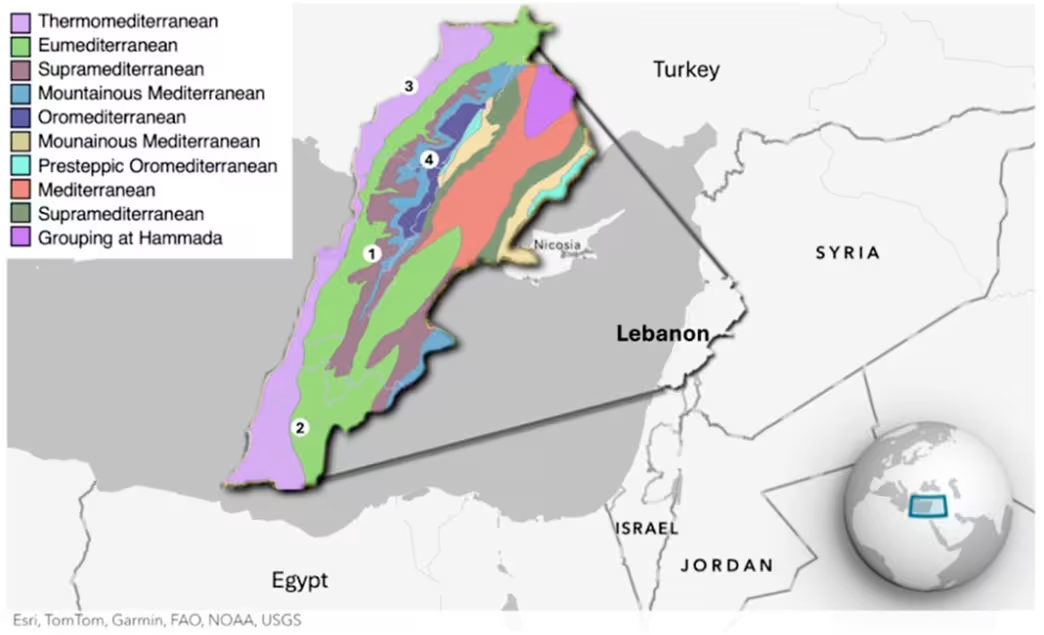
Map showing the four sampling sites in Lebanon where Malaise traps were deployed: Bnebil (#1), Wadi El Houjeir (#2), Ras Maska (#3), and Ehden (#4). The map was generated using ArcGIS. Basemap data were provided by Esri, TomTom, Garmin, FAO, NOAA, USGS, and other contributors. Colors were enhanced using Adobe Photoshop. Shaded areas indicate the principal bioclimatic zones across the country.
A foundation, not a finish line
The authors are clear that this survey is a starting point. Expanding geographic coverage, including Lebanon’s under sampled southern regions and high-altitude habitats and broadening taxonomic resolution will be essential to fully capture the country’s entomofaunal richness. Further work integrating morphological expertise with molecular tools will help resolve the many BINs that remain unlinked to named species.
Yet for the Mediterranean forest research community, this study delivers something of lasting value: a robust, openly accessible baseline built on rigorous methodology. Its significance extends well beyond Lebanon’s borders.

"At a moment when insect populations across Europe and the Middle East are under mounting pressure from habitat loss, pesticide use, and a shifting climate, knowing what is there, in molecular detail, is the prerequisite for protecting it."
-
Rhea Kahale

Related content
The forest that refused the rulebook
Journalists, scientists and forest experts explore how different perspectives shape decisions on forest health and post-disturbance management in…
- Forests and people
From clear-cutting to continuity
It was a dark and murky evening as I paved my way through Harcourt Street in Dublin. That’s when I suddenly found myself in a pub.
- Resilient forests
What is forest biodiversity?
Forest biodiversity includes not only species diversity, but also the variety of functions they perform, from genes to landscapes.
- Resilient forests