
Nature as cities' cooling infrastructure: EFI Biocities webinar explores urban forests for climate adaptation
How can cities stay liveable as temperatures keep rising? This past summer brought intense and prolonged heatwaves, with record temperatures in many parts of the world, including Europe, exposing the vulnerability of urban areas to extreme heat. According to the experts at EFI Biocities' second webinar, part of the answer lies in urban forests and nature-based solutions, which can act as cooling infrastructure if they are well planned, designed, and managed.
Held on 30 September, the session Urban forests for climate change adaptation, co-organised with the European Forum on Urban Forestry (EFUF) and moderated by Simone Borelli (EFI), brought together global, local, and academic perspectives on one of the most pressing challenges facing cities today.
Opening the session, Ilaria Doimo, newly appointed Lead of EFI Biocities, presented the initiative as a platform connecting science, policy, and practice. Clive Davies (Chairman, EFUF) then introduced the forum's work and its next annual meeting, to be held in Leipzig in June 2027.
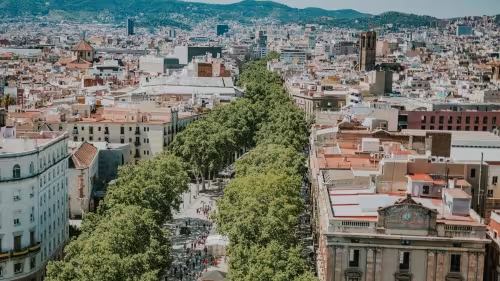
Eleni Myrivili (Global Chief Heat Officer, UNEP/Cool Coalition) set the scene, showing that cities are warming twice as fast as surrounding areas and that heat is unevenly shared. It deepens existing inequalities, often hitting hardest the most neglected neighbourhoods, where nature is scarce. In Barcelona, for example, surface temperatures can differ by up to 15°C between neighbourhoods. "We cannot air-condition our way out of this," she warned, calling for passive cooling first and for mitigation and adaptation to go hand in hand. She also cautioned against tree-planting targets: "We don't plant trees, we plant soil". Rather than counting trees, she explained, cities should focus on choosing the right species for the right place and on creating healthy soil, without which trees cannot thrive or deliver their cooling benefits. Her three main takeaways: heat is unequal, nature is infrastructure, and performance matters.
From Portugal, Ana Sousa (Landscape Architect, Laboratório da Paisagem, Guimarães) showed what this looks like on the ground. Between 2013 and 2023, the share of the municipality with surface temperatures of 35–40°C rose from 11% to 42%. In response, Guimarães is developing 61 km of greenways along its three rivers, has involved residents in planning its carbon-neutral District C through citizens' assemblies, and is creating a three-ring Green Belt that will connect existing green spaces and reach 74% of the population. Ongoing local research also suggests that excessive or incorrect pruning can noticeably reduce the cooling effect of trees.
Fabio Salbitano (Professor, University of Sassari) drew the threads together, highlighting the role of building materials, tree species diversity, and urban forests, which have the greatest cooling potential of any nature-based solution. He stressed two essentials: ecological design and adaptive management based on "observe, act, check". Designing a city for cooling, he noted, "is a process that requires competence, professional skills, people engagement, continuity, equity, reliability, and resources".
Despite different perspectives, all speakers agreed that cooling cities with nature requires long-term planning, sustained investment, and a focus on the people most at risk.
As the webinar series continues, EFI Biocities aims to help cities turn knowledge about nature-based cooling into lasting action. A technical brief summarising the main questions and answers from this session will follow shortly, and the next webinar will be announced soon on EFI's website and social media channels.
Related content
EFI Biocities webinar: Urban forests for climate change adaptation
Urban heat is rising, and green infrastructure is part of the answer. Explore how at the next EFI Biocities webinar. Register now!
- Cities
EFI Biocities webinar: Urban forests for climate change adaptation
Urban heat is rising, and green infrastructure is part of the answer. Explore how at the next EFI Biocities webinar on 30 September.
30 September 2026, 17:00–18:30
- Cities
EFI Biocities new webinar series: healthy cities by nature
EFI Biocities is launching a new webinar series exploring how cities can integrate nature into urban development.
- Cities
