This report analyses available practices using the four QU.A.L.ITY criteria established by the EU: quantification (carbon removal must be accurately measured), additionality (carbon removal must go beyond standard practices), long-term storage (carbon must be removed at least for five years) and sustainability (multifunctionality, climatic resilience, biodiversity, etc.). These management practices must avoid leakage (transfer of activities resulting in carbon emissions elsewhere).
All of these practices must be carefully tailored to local climatic and forest conditions to balance the potential carbon benefits with the risks of carbon losses due to natural disturbances. These practices not only contribute to carbon sequestration but can also improve forest health, biodiversity and overall ecosystem resilience.
Citation
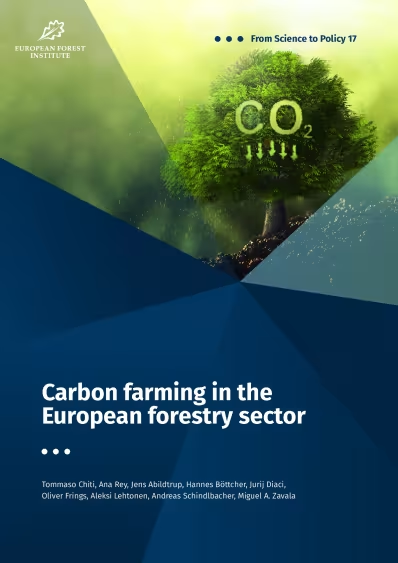
Chiti, T., Rey, A., Abildtrup, J., Böttcher, H., Diaci, J., Frings, O., Lehtonen, A., Schindlbacher, A., Zavala, M.A. 2024. Carbon farming in the European forestry sector. From Science to Policy 17. European Forest Institute. https://doi.org/10.36333/fs17
Number of pages: 88
ISSN 2343-1229 (print)
ISSN 2343-1237 (online)
ISBN 978-952-7426-90-6 (print)
ISBN 978-952-7426-91-3 (online)
-
Tommaso Chiti

Ana Rey
Jens Abildtrup
Hannes Böttcher
Jurij Diaci
Oliver Frings
Aleksi Lehtonen
Andreas Schindlbacher
Miguel A. Zavala
Related content
Forest-based climate change mitigation and adaptation in Europe
How much forests and wood use can contribute to climate change mitigation, and how that contribution can be maximised?
- Resilient forests

Wildfires are Europe’s new normal: why we urgently need to act
EFI experts urge moving from managing each fire as an isolated emergency to managing fire risk across landscapes and throughout the year.
- Resilient forests
Dynamic and static ex situ conservation: minimum requirements, data standards and indicators for monitoring
EUFORGEN report clarifies terminology, sets minimum requirements and standards, and guides dynamic ex situ FGR conservation.
- Resilient forests