Revisiting the climate benefits provided by wood through future-oriented material and energy displacement
Does wood keep its climate advantage in the future?
Using wood instead of materials such as steel, cement or glass often causes lower fossil greenhouse gas emissions. This benefit is expressed as a "displacement factor": the higher it is, the more emissions are avoided by choosing wood. These factors are usually based on today's production methods, but other industries are expected to become cleaner over time.
In a new open-access paper in Environmental Science & Technology, Müller et al. examined 81 variants of wood products and materials from 2020 to 2070 under three decarbonisation scenarios.
Main findings
- In 2020, wood products generally had an advantage over their alternatives, but it was smaller than previously estimated and varied widely, being close to zero for furniture.
- The advantage shrinks over time for all product groups except chemicals, mainly because the non-wood alternatives decarbonise faster. It remains largest in the least ambitious climate scenario.
- Long-lived material uses of wood perform much better than energy use, where the benefit is close to zero by 2070.
Why it matters
The results support shifting wood from energy towards long-lived products. They also caution against justifying increased harvesting on displacement arguments alone. Note that these factors cover fossil emissions only, not the biogenic carbon released or stored in forests and wood.
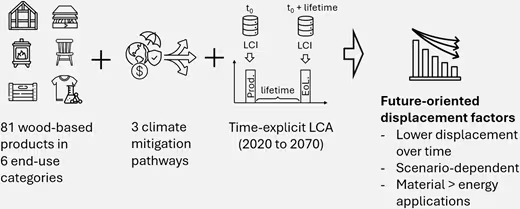
This visual abstract was provided by the authors.
The paper and its open database are available here.
Citation
Müller, A., Martinez, . G.E., Verkerk, P.J., Guinée, J., Steubing, B., Cardellini., G. (2026) Revisiting the Climate Benefits Provided by Wood through Future-Oriented Material and Energy Displacement. Environmental Science & Technology. https://doi.org/10.1021/acs.est.6c10525

Related content
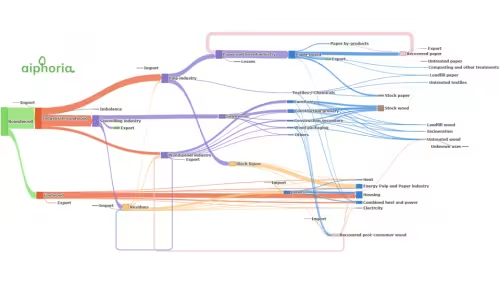
aiphoria: A Python package for dynamic wood material flow and carbon stock analysis
aiphoria is an open-source Python package for dynamic material flow analysis (DMFA) of wood.
- Sustainable economy
Building the future
ThinkForest event explored how wood and other construction materials can complement each other to build more sustainable, affordable and resilient.
- Sustainable economy

Building the Future: Wood, Bioeconomy and the New Bauhaus
This ThinkForest event explores how wood and other bio-based materials can contribute to a sustainable and climate-neutral European built environment.
19 November 2026, 09:00–11:30
- Sustainable economy