Biodiversity in sustainability reporting and forest-related indicators
Alongside greenhouse gas emissions and resource management, biodiversity is an important component of sustainability reporting.
The improvement of methods and indicators has contributed to the growing role of biodiversity in reporting, as frameworks become more accurate and credible. In the forest realm, Forest Europe’s ten forest-related biodiversity indicators provide one framework for approximating biodiversity levels.
As part of the Horizon Europe CircHive project, Diana Tuomasjukka, EFI, works on advancing biodiversity measurement and indicators. In a recent interview, she explains how biodiversity is assessed, how indicators are chosen, and how monitoring approaches vary across contexts.

"Indicators are proxies for the whole. They do not cover the entirety, but it's the closest approximation to give information on how biodiversity in general terms is doing"
Growing demand from markets and regulation
Demand from both the market and public regulatory frameworks has also contributed to the growing attention on biodiversity. While the voluntary adoption of reporting is encouraged on the private side by programmes such as the Global Reporting Initiative, policies also provide regulated reporting standards. For example, the Corporate Sustainability Reporting Directive (CSRD) and Regulation on Sustainable Finance (Taxonomy) regulate reporting in the EU.
Biodiversity reporting by companies is shaped by the developing methods available and demand from both the public and private sectors. However, what approach a company or organisation adopts is also dependent on their strategy and goals.
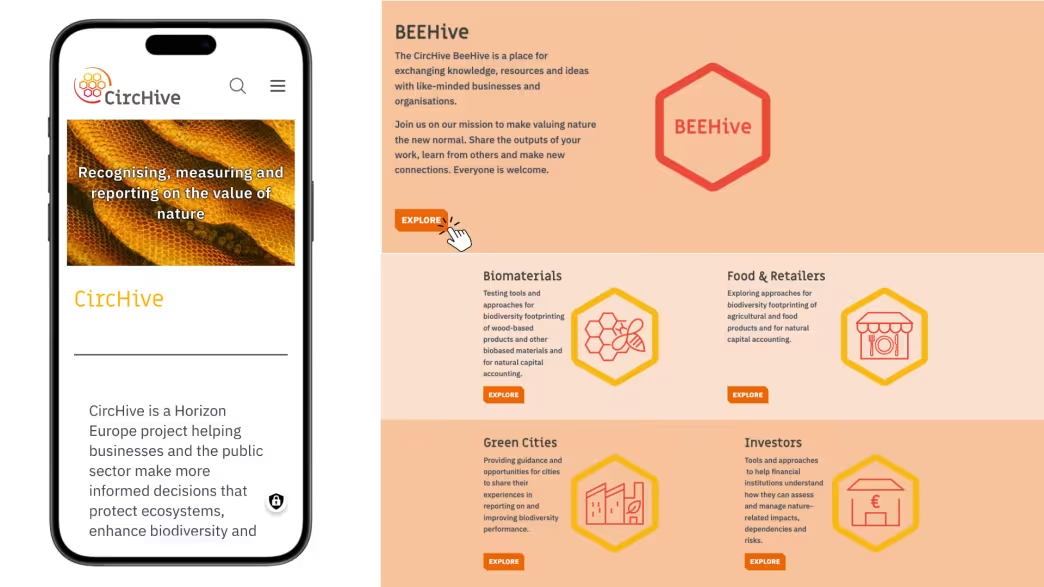
BEEHive is a platform for exchanging experiences with these approaches and the latest thinking, research, and advances on biodiversity. A product of the CircHive project, BEEHive is a new online community supporting nature-positive and sustainable business and brings together companies, researchers, and policymakers to develop the role of biodiversity in four sectoral hubs: Biomaterials, Food & Retail, Finance, and Green Cities.
After its launch last month, BEEHive is up and running. It is free to join and open to any organisation or individual interested in learning how to measure and manage their impacts on nature.
Learn more and join a hub: circhive.eu/beehive
Watch an interview with Luke Senior Scientist Erika Winquist, who explains why biodiversity matters for the circular bioeconomy, and introduces the core components of the CircHive project.
Watch an interview with EFI Senior Researcher Mohammad Naji, who offers a perspective on integrating life cycle assessment with NCA to capture biodiversity impacts better.

Related content
The forest that refused the rulebook
Journalists, scientists and forest experts explore how different perspectives shape decisions on forest health and post-disturbance management in…
- Forests and people
Priority actions for the conservation of primary and old-growth forests in Europe
New paper outlines four priority actions to better protect Europe's remaining primary and old-growth forests.
- Resilient forests
De mémoire d’arbre: five centuries through the eyes of a tree
To celebrate World Book Day, Magda Bou Dagher Kharrat, Principal Scientist at EFIMED, recommends one of her recent favourite reads.
- Forests and people