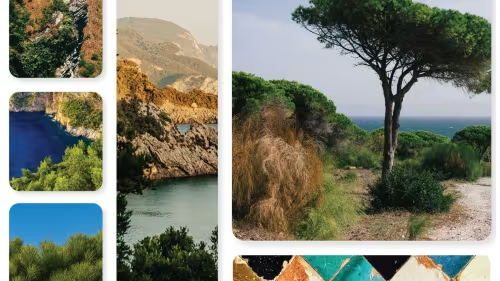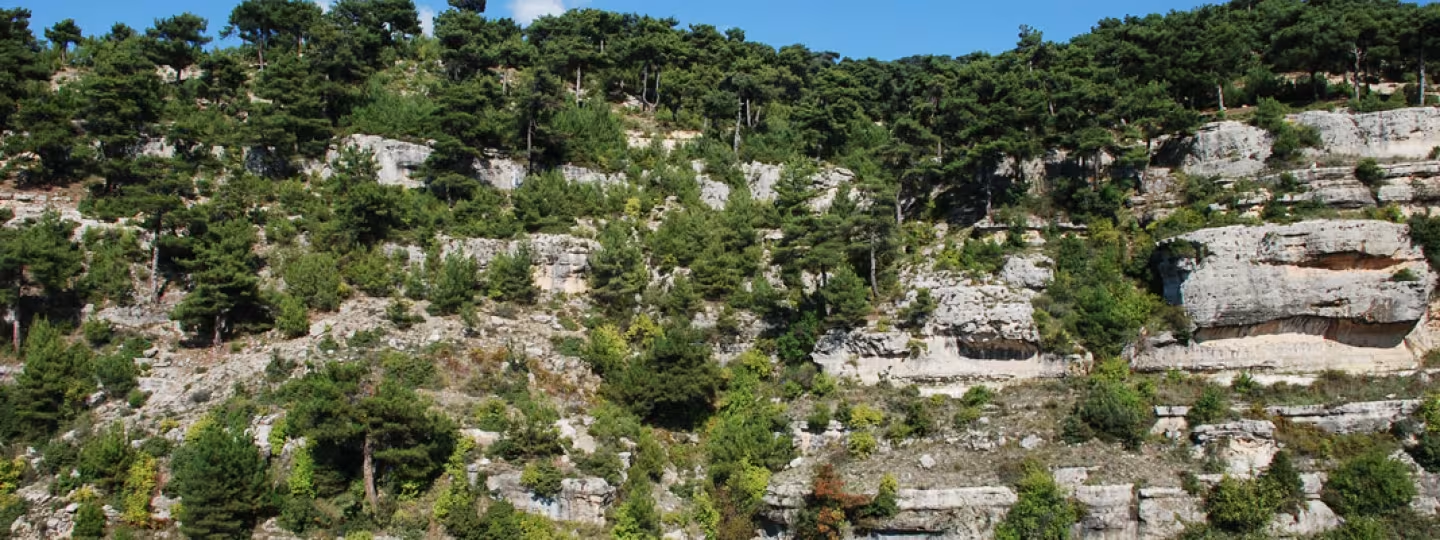
Native trees of the Mediterranean region: distribution, diversity and conservation challenges
Why do we love trees? It is not because they store carbon (although they do), it is not because they are threatened by climate change and other human-made disruption (although they are), it is not because we use their wood and other parts (although we do). I believe it is because they are so massive, strong, ancient, tall and big, and because, together, they make these amazing structures that cover almost a third of our planet and are so full of life: forests!
So, tall and big. The tallest trees on Earth are taller than 100 metres, yet most trees in European temperate and Mediterranean forests are 10 to 40 metres high at best. But what is the minimum “bigness threshold” that allows a tree to be called a tree?
This is the kind of question you have to ask yourself when you are set to carry out an inventory of the presence of trees, as we did for the Mediterranean. And with rapidly changing environmental conditions, especially in the Mediterranean, the question of potential also needs to be asked. Could a life form most often characterised as a bush or a shrub actually be a tree if its habitat changed, for instance when encountering a more fertile environment as climate or protection status are changing?
With these considerations in mind, we recognised as being a tree those woody plants that could achieve an adult total height of at least 3 metres, with a clear trunk and lower branches naturally pruned and not touching the ground.
Just as trees are a bit tricky to define, defining what is the Mediterranean region in North Africa, Western Asia and Southern Europe is not a straightforward task. Many definitions of what is the Mediterranean exist, depending on one’s point of view or experience, whether bioclimatic, biogeographic, floristic or cultural (such as the cultivation of the olive tree). In our inventory, we chose a definition including climatic (summer drought) and floristic components, encompassing a region spanning from Morocco and Portugal to Iran and Iraq.
It is these trees, naturally or unexpectedly big or small, that we have recorded and whose distribution we have analysed in the inventory of all Mediterranean trees of North Africa, Western Asia and Southern Europe, just published in Current Forestry Reports. Putting together the knowledge and expertise of over 30 botanists from a wide range of Mediterranean countries, we recognised 643 species and subspecies of trees growing in 39 well-defined botanical territories, including 56 species and subspecies that we recognised as trees although generally characterised as shrubs (thus cryptic trees). We also excluded 96 species and subspecies sometimes recognised as trees but that are true shrubs in the Mediterranean. These trees and shrubs are listed in an open-access database.
Analysing the data, we found that most tree species had not been assessed for risk of extinction. We also found that while those used commercially were generally genetically characterised, most tree species were not. This lack of knowledge is worrisome, as lack of knowledge is often associated with too little concern for sustainable management.
An inventory is an indispensable tool for research and for prioritising conservation actions. We hope this inventory will help do just that, and more, by fostering collaboration among Mediterranean countries for the sake of their beautiful trees.
Reference
Fady B., Farsakoglou A-M., Caron M., Abulaila K., Aleksic J., Alipour S., Balian D., Bedair H., Bogunić F., Cheikh Albassatneh M., David-Schwartz R., Delgado Clavero C., Dönmez A.A., Fennane M., Gateble G., Gauquelin T., Hachi Illoul M., Khaldi A., Mahfoud-Saad I., Médail F., Mezni F., Muhammed J.J., Muys B., Perovic M., Saaed M., Seregin A.P., Stephan J., Vela E., Zhelev P., Bou Dagher Karrat M., 2025. Native trees of the Mediterranean region: distribution, diversity and conservation challenges. Current Forestry Reports 11, 20.
This study was funded by INRAE and the European Forest Institute’s Mediterranean Facility (EFIMED).
This article was originally authored by Bruno Fady, Researcher at INRAE, Ecology of Mediterranean Forests Research Unit (URFM).
-
Bruno Fady

Related content
The forest that refused the rulebook
Journalists, scientists and forest experts explore how different perspectives shape decisions on forest health and post-disturbance management in…
- Forests and people
Forests of the Future: Research and forest management in an era of change
Contemporary approaches to forest ecology, close-to-nature silviculture, biodiversity, monitoring, and long-term research.
17 September 2026 – 20 September 2026
- Resilient forests
Voices of the Mediterranean Forests: apply now for a media workshop on Forest Genetic Resources
Apply by 15 August for a fully funded media workshop on Forest Genetic Resources in Barcelona, 30 November to 2 December 2026.
- Resilient forests