What takes a new landowner from inaction to stewardship?
Economic incentives for wildfire risk managementNew landowners often leave inherited land unmanaged, spreading wildfire risks widely. Our research identifies economic incentives, including subsidies, payments, insurance discounts, and collective action that effectively motivate stewardship and shared responsibility
Imagine you live in a city: office schedules, metro commutes, evening beers and dinners with friends. One morning, you receive a letter from a notary: your late aunt has left you a piece of land in the countryside several hours away. You vaguely remember visiting as a child: a patchwork of old pine trees and dry meadows sloping towards a valley.
You visit the land one weekend. The path is overgrown, the forest thick with dry shrubs and fallen branches—clear signs of long neglect. A neighbour mentions a recent fire in the nearby valley. Back in the city, you face an uncomfortable truth: managing the land would be costly and time-consuming, with little economic return. Like many new owners, you decide to leave it as it is.
What is less visible, however, is that the risks and costs associated with that decision—such as increased wildfire hazard—are not borne equally, but often spread across neighbours, communities, and public services.
This scenario plays out across Mediterranean Europe. Five decades of rural exodus have left hundreds of thousands of hectares abandoned and unmanaged. Fuel accumulates. Extreme climate conditions worsen the threat. Fire becomes not only an ecological problem but also a social and economic one. Here, research begins to ask an urgent question: what would motivate a new generation of landowners to act?
Mapping the incentive landscape
Our recent research (Fraccaroli et al., 2026 – Economic incentives for reducing wildfire risk: taking stock of an emerging field) categorises the tools that shift “doing nothing” into active stewardship. We identified incentives across multiple channels:
- Bureaucratic: public subsidies, grants, with some regulatory tools such as liability for inaction, and recognition for landscape resilience contribution
- Market: payments for fuel reduction, carbon credits, wildfire insurance discounts, commodity markets
- Social: community programmes, Firewise certifications, land cooperatives that share management costs
To build this picture, we compiled 80 case studies in an open-access database, drawn from across fire-prone regions worldwide.
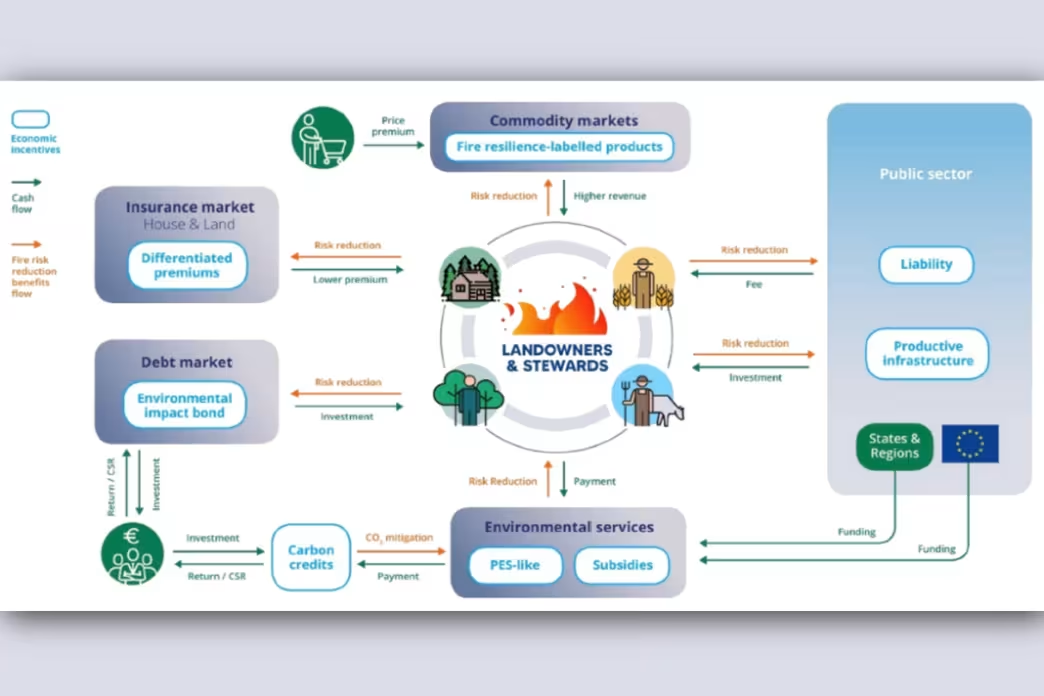
Figure 1: The economic incentives landscape for wildfire risk reduction, showing how cash and fire-risk-reduction benefits flow between landowners and stewards, market instruments (insurance, debt, commodity and carbon markets), environmental services, and the public sector. (Fraccaroli et al., 2026)
The economics of different approaches
Not all incentives perform equally. The research reveals trade-offs.
Payments for Ecosystem Services (PES) can be attractive in theory—paying shepherds to graze livestock in firebreaks, for instance—but often carry hidden costs. PES requires continuous payment, monitoring, verification, and sometimes third-party certification. Subsidies, by contrast, may have substantial upfront expenses, particularly when framed as productive public investment: converting abandoned land into self-sustained private enterprises. Overall, PES schemes tend to spread costs over time and can be more flexible, whilst subsidy-based approaches frontload investment and are more vulnerable if projects fail before they become self-sustaining. In both cases, when successful, incentive-based approaches substantially reduce long-run fuel management costs relative to business-as-usual, but PES-like grazing schemes appear more flexible and financially resilient.
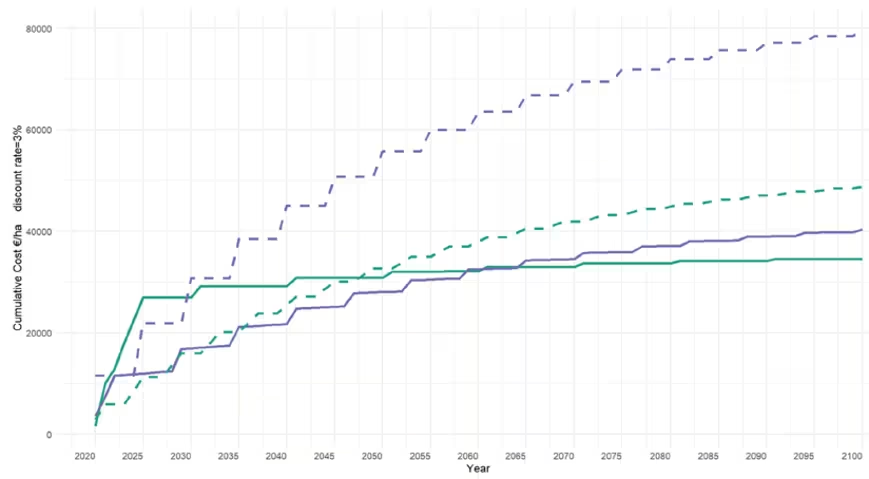
Figure 2: Cumulative fuel-management cost per hectare (€/ha, discount rate 3%) from 2020 to 2100 under different incentive scenarios. Costs rise steeply in the first decade before flattening, with [dashed lines / colour] reaching roughly €49,000–79,000/ha by 2100 and [solid lines / colour] stabilising around €34,000–40,000/ha, illustrating the long-run savings of incentive-based approaches relative to business-as-usual. (Fraccaroli et al., 2026)
Among the 80 cases, we look beyond the Mediterranean context to consider different unmitigated scenarios. The challenge varies by region. In the USA, prescribed burning is more common, yet landowners may be reluctant to use it. The barriers? High liability if a fire escapes control, expensive equipment, and lack of training and capacity. Our research found that associationism—where landowners and managers pool resources and share responsibility—overcomes these obstacles. They combine personal funding with public grant applications, spreading both costs and liability. Alternatively, Firewise communities take this further, uniting residents at the urban-forest interface and aligning different agencies, organisations, and private citizens around shared risk.
Australia offers another model. Aboriginal communities generate carbon offsets from prescribed burns that reduce emissions. Meanwhile, utilities face an unusual incentive: those experiencing more ignitions than a target baseline may see customer rates reduced the following year, whilst those with fewer ignitions earn a bonus. The mechanism turns infrastructure vulnerability into a performance metric.
The deeper finding cuts across all these models: people respond not only to financial incentives but also to meaning and shared responsibility.
The challenge is stark: ownership no longer guarantees management. The next generation of landowners hold the keys to landscape resilience, yet that traditional relationship between owning and stewarding has fractured. Rebuilding it requires recognising that wildfire risk is not a private problem but a shared challenge that binds rural and urban, neighbours and strangers, present and future.
Reference
Fraccaroli, C., Górriz-Mifsud, E., Varela, E., & Wunder, S. 2026. Economic incentives for reducing wildfire risk: Taking stock of an emerging field. Journal of Environmental Management, 397, 128296.

Related content
Economic incentives for reducing wildfire risk
Taking stock of an emerging field
- Sustainable economy

FIRE-RES
EU-funded FIRE-RES tackles extreme wildfires with early detection tech, landscape planning and fire-resilient bioeconomies.
- Resilient forests

INTERCEDE
Incentivising future forest ecosystem services and incomes in Europe
- Sustainable economy