Voices of the Mediterranean Forests: Media Workshop on Forest Genetic Resources
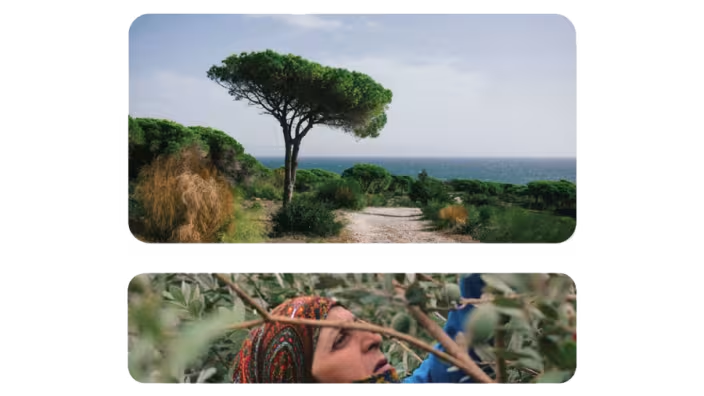
Mediterranean forests hold an extraordinary wealth of genetic diversity; the invisible foundation of biodiversity, resilience, and climate adaptation. Yet Forest Genetic Resources (FGR) remain largely absent from public conversation, even as climate change and habitat loss threaten this vital natural heritage.
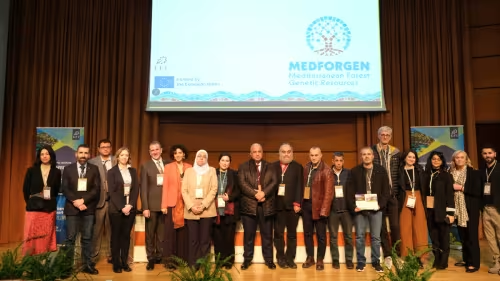
The Mediterranean Forest Genetic Resources (MEDFORGEN) project, led by EFI Mediterranean (EFIMED) and funded by the EU, is the first cross-border initiative dedicated to strengthening the conservation of FGR across the Mediterranean region.
As part of these efforts, Voices of the Mediterranean Forests is a fully funded, two-day workshop bringing together 12 journalists and environmental communicators from across the Mediterranean to uncover the stories behind FGR and transform complex science into compelling narratives. Through inspiring talks, interactive workshops, collaborative learning, and networking, participants will gain practical tools to communicate biodiversity and forest resilience more effectively. They will leave with a communication strategy ready to engage audiences at home and join a growing network of communicators dedicated to giving a voice to Mediterranean forests.
Objectives
- Build a network of informed Mediterranean communicators equipped to report on FGR and related biodiversity topics.
- Co-create culturally adapted communication strategies, messages, and formats for each participating country.
- Showcase and test innovative tools: digital storytelling, storymaps, animation, photography, sound, and community-based media.
- Strengthen the link between scientific evidence and public engagement in support of forest conservation and the bioeconomy.
Who should apply?
Active journalists, science communicators, photographers, filmmakers, podcasters, and digital content creators from Mediterranean countries with an interest in environmental topics.
Applications are now closed.
What will you do?
You will walk away from this workshop with new skills, fresh perspectives, and a network of forest communicators ready to change how the Mediterranean talks about nature and develop a solid understanding of Forest Genetic Resources and their crucial links to ecosystem health and resilience.
Get creative & hands-on
- Master innovative communication formats: digital storytelling, social media strategies, and storymaps
- Discover community-based storytelling adapted to your region's unique media landscape
- Co-create a tailored communication strategy for your country or region that speaks to your audience
Connect & celebrate
- Build a lasting professional network of like-minded forest communicators across the Mediterranean basin
- Exchange insights with peers across the Mediterranean on how culture, language, and media shape environmental storytelling
Application process
How to apply?
Voices of the Mediterranean Forests is a fully funded, 3-day media workshop bringing together up to 12 journalists and communicators from across the Mediterranean for intensive training in forest biodiversity communication. The workshop takes place 30 November – 2 December 2026 in Barcelona, Spain, and is conducted entirely in English.
What to submit
Submit your application through our online form (takes approximately 15–20 minutes to complete). Your application must include:
- A short biography (max. 200 words) describing your background and current work
- A motivation statement (max. 300 words) explaining why you want to participate and what you would bring to the group
- Links to 2–3 examples of your published or produced work (articles, videos, podcasts, photo essays, etc.)
- Your country of residence and primary working language(s)
Applications are now closed.
Selection criteria
Candidates will be selected through an open call disseminated by German Embassies across the Mediterranean region.
Selection will follow transparent, standardised criteria including : professional background in media or science communication, demonstrated interest in environmental topics, geographic diversity, and language representation (Arabic, French, Italian, Spanish, Greek, Turkish and others).
Contact us
Questions?
We are here to help! Whether you are curious about the workshop content, have questions about the application process, or need support with your submission, don't hesitate to reach out.
Get in touch
Email: maria.gonzalez@efi.int
Practical information
What we provide, what you bring
Selected participants will receive support to attend the workshop, including return international travel to Barcelona, three nights of accommodation, meals during the event, workshop materials and resources, and participation in the social dinner on the first evening.
In return, we ask participants to bring their curiosity, creativity, and knowledge of their country's media landscape. As a collaborative workshop, the programme relies on the active exchange of experiences, ideas, and perspectives from across the Mediterranean.
Participants are also expected to contribute actively throughout the workshop and commit to producing one communication output after the event, helping to raise awareness of Mediterranean forests, biodiversity, and Forest Genetic Resources.
Venue
We are delighted to be hosting the Voices of the Mediterranean forests workshop in Sant Pau Art Nouveau Site (Recinto Modernista de Sant Pau, in Spanish), declared World Heritage by UNESCO in 1997 for its singularity and artistic beauty. The Art Nouveau Site comprises an architectural complex of 12 pavilions set in green space and interconnected by a kilometre of underground galleries.
Part of the Administration Pavilion has been converted into a venue for meetings and events. Read more about the venue.
How to get to the venue?
The workshop will mainly take place at the EFI's Mediterranean office, which is located inside the historic site. To reach the event venue, you must enter the site through the main entrance at the corner of Carrer de Sant Antoni Maria Claret and Carrer de Cartagena. To get there, you can use these means of transport:
- Metro: Yellow line (L4) to Guinardó/Hospital de Sant Pau or Blue line (L5) to Sant Pau/Dos de Maig
- Bus: Bus lines 15, 19, 20, 45, 47, and 92
- Taxi: Indicate Sant Pau Historic Site, entrance Carrer Cartagena with Carrer Sant Antoni Maria Claret.
Travelling to Barcelona
Visa requirements
The entry to Spain of foreign nationals is subject to the Schengen Acquis. As a rule, foreign nationals who need an entry visa are requested to apply for one at the diplomatic mission representing Spain in their home country.
How to reach Barcelona
Barcelona is an international hub and major destination in Europe with direct connections to many European and extra-European destinations. We recommend travelling directly to Barcelona El Prat Airport where possible, or via Madrid (with a flight connection) if direct flights are not available.
In the less likely case of needing to travel from Madrid (not by plane), there are several connections between the two cities, both by coach and train .
A train from Madrid to Barcelona takes approx. 3 hours. Cost for a one-way ticket is approx. 70 €, also depending on how early the tickets are booked.
Organising partners

European Forest Institute Mediterranean (EFIMED), Barcelona
Lead organiser responsible for scientific content, participant selection, and communication.
German Consulate General, Barcelona
Funder and diplomatic convener, coordinating outreach through German Embassies across Mediterranean countries and supporting open call dissemination and participant recruitment.
Related content
EFI launches MEDFORGEN project
The project focuses on ten countries in the EU Southern Neighbourhood: Algeria, Egypt, Israel, Jordan, Lebanon, Libya, Morocco, Palestine, Syria, and…
- Resilient forests
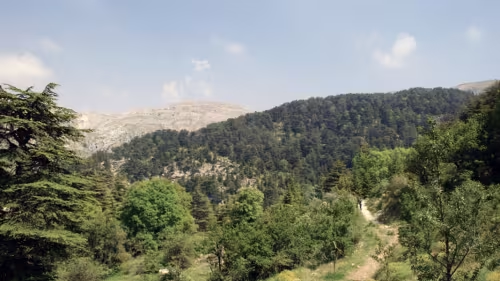
MEDFORGEN launched to protect forest genetic resources across the Mediterranean
MEDFORGEN was launched last March as a coordinated effort to safeguard the genetic diversity of forest ecosystems across the Mediterranean region.
- Resilient forests
MEDFORGEN
A collaborative effort to safeguard the genetic diversity of forest ecosystems across the Mediterranean region.
- Resilient forests