Crossing the valley of death: Scaling forest-based innovations in Europe
Europe has a world-class research and innovation ecosystem, yet many forest-based innovations struggle to reach the market, even more, to do it at scale. They fail to traverse the so-called “valley of death”, a critical phase between early-stage R&D, pilot production, and commercial viability.
Many different factors are behind this bottleneck: lack of entrepreneurial culture and risk aversion, market fragmentation and suboptimal funding schemes that cannot match the high capital needs. They need to be properly identified and systematically addressed.
Which are the challenges?
- A risk-averse innovation culture across Europe
Discourages experimentation and first-of-a-kind investments, as industries, governments, and investors want to avoid failure rather than learn from it. - High investment risk and long-return periods
Deter private investors, as forest-based innovations frequently require costly infrastructure and equipment (high CAPEX) to move from pilot to commercial scale, in context of evolving technologies. - Publicly supported open-access scaling facilities remain underused
Due to low awareness, missing dedicated funding, limited cross-border access, and administrative bottlenecks. - Funding is fragmented across EU, national and regional instruments
Often with different eligibility criteria, and short project cycles. This especially affects SMEs and smaller innovation actors. - A complex and evolving EU regulatory environment
Creates uncertainty for the private sector, while insufficient policy incentives fail to counter fossil-based market dominance. -
Weak research-finance-business collaboration
Hampers entrepreneurial skills of bioeconomy researchers and investors’ understanding of the specific risks and opportunities in the forest bioeconomy.
What can policymakers do?
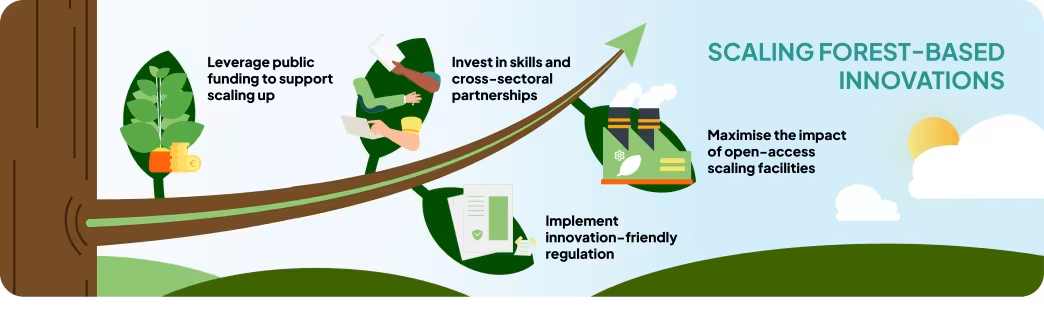
- Implement innovation-friendly regulation
• Assess EU’s regulatory barriers, accelerate processes, and support SMEs in achieving compliance with complex regulations.
•Use innovative and green public procurement, material quotas, and other incentives to drive sustainable market demand for bio-based innovation.
•Complement demand-side tools with outcome-based incentives (e.g., climate/ biodiversity performance) to improve competitiveness of forest-based versus fossil-based innovations. - Leverage public funding to support scaling up
• Adopt risk-aware approaches that accept innovation uncertainty (including learning from failure) and support first-of-a-kind scale-up.
• Use public funds to de-risk investments through guarantees and blended finance.
• Design adaptive, long-term funding programmes, e.g., milestone-based funding.
• Align EU–national–regional instruments and their eligibility criteria to provide a continuous pathway from R&D to deployment and commercial scale, speeding up funding decisions and reducing co-financing barriers for SMEs and small producers. - Maximise the impact of open-access scaling facilities
• Avoid duplication of same-technology scaling infrastructures while existing ones stay underutilised.
• Facilitate access to existing scaling infrastructures across borders through targeted public grant schemes (e.g., vouchers or subsidised access schemes for SMEs).
• Pair access to technical facilities with business mentoring, funding readiness, and market-entry support. - Invest in skills and cross-sectoral partnerships
• Train bioeconomy researchers in entrepreneurship and educate investors on bioeconomy risks and opportunities. Integrate business skills into life sciences and forestry curricula, and strengthen advisory/extension capacity.
• Public-private partnerships foster knowledge sharing and collaboration across the main sectors related to bioeconomy.
• Support the emergence of investment funds, and other innovation support initiatives fully dedicated to the forest bioeconomy, ideally bundling finance with capacity building (technical assistance, coaching, and partnership-building).
Citation
Briers, S., Martinez de Arano, I., Živojinović, I., Caurla, S., Enache, A. (2026) Crossing the valley of death: Scaling forest-based innovations in Europe. EFI Policy Brief 23. European Forest Institute. https://doi.org/10.36333/pb23
-

Sylvain Caurla
Adrian Enache
Related content
Regional Bioeconomy in Action
Explore how regions across Europe are advancing the bioeconomy transition, from forestry and agricultural regions to coastal communities.
19 October 2026, 13:30–16:00, GMT, UTC+0
- Co-created solutions

Young professionals are invited to rethink the future of forests at EFI YLP 2026
Early-career professionals from across Europe will gather in Joensuu, Finland, to explore innovation and futures thinking for forests.
- Co-created solutions

Major collaboration agreement between regional bioeconomy networks
The agreement establishes a formal framework with the aim of accelerating the deployment of bio-based innovation at regional level across Europe.
- Sustainable economy