Ecosystem services and disservices of forests and greenspaces
A pan-European representative study of societal perceptions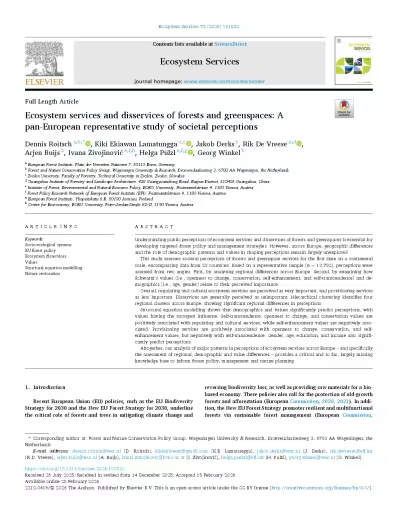
Understanding public perceptions of ecosystem services and disservices of forests and greenspaces is essential for developing targeted forest policy and management strategies. However, across Europe, geographic differences and the role of demographic patterns and values in shaping perceptions remain largely unexplored. This study assesses societal perceptions of forest and greenspace services for the first time on a continental scale, encompassing data from 33 countries. Based on a representative sample (n = 10,782), perceptions were assessed from two angles: first, by analysing regional differences across Europe; and second, by examining how Schwartz’s values (i.e., openness to change, conservation, self-enhancement, and self-transcendence) and demographics (i.e., age, gender) relate to the perceived importance of these services.
Citation
Roitsch, D., Lamatungga, K. E., Derks, J., De Vreese, R., Buijs, A., Živojinović, I., Pülzl, H., & Winkel, G. (2026). Ecosystem services and disservices of forests and greenspaces: A pan-European representative study of societal perceptions. Ecosystem Services, 78, Article 101832. https://doi.org/10.1016/j.ecoser.2026.101832



Related content
Guidelines for urban forests as nature-based solutions (UF-NBS)
Guidelines for urban decision-makers on managing trees and urban forests as nature-based solutions, drawing on research from Europe and China.
- Cities
Wildly diverse: How Europeans vary in their views on forest landscapes
Do Europeans prefer wild or cultivated forests? A pan-European survey shows preferences vary by age, gender, place of residence, and region.
- Forests and people

Socio-demographic and geographical patterns in forest and park use
A survey of 10,462 people in 33 countries shows how age, gender, region, and access shape the use of forests and parks in European cities.
- Forests and people