Socio-demographic and geographical patterns in forest and park use
Insights from 33 European countries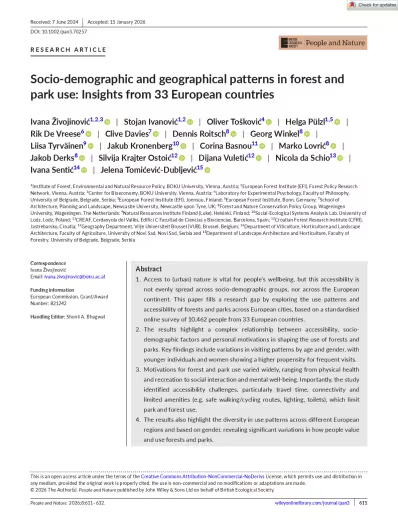
Access to urban nature is vital for people’s well-being, yet it is not shared equally across social groups or across Europe. This study fills a research gap by examining how people use and access forests and parks in European cities, drawing on a standardised online survey of 10,462 people from 33 countries.
The results reveal a complex interplay between accessibility, socio-demographic factors and personal motivations. Younger people and women are more likely to visit green spaces frequently. Motivations vary widely, from physical health and recreation to social interaction and mental well-being. However, practical barriers limit use for many: long travel times, poor connectivity and a lack of amenities such as safe walking and cycling routes, lighting and toilets.
Use patterns also differ considerably between European regions and by gender, showing that people value and use forests and parks in diverse ways. The authors conclude that inclusive urban planning is essential to ensure that green spaces meet the varied needs and preferences of all residents.
Citation
Živojinović, I., Ivanović, S., Tošković, O., Pülzl, H., De Vreese, R., Davies, C., Roitsch, D., Winkel, G., Tyrväinen, L., Kronenberg, J., Basnou, C., Lovrić, M., Derks, J., Ostoić, S. K., Vuletić, D., da Schio, N., Sentić, I., & Tomićević-Dubljević, J. (2026). Socio-demographic and geographical patterns in forest and park use: Insights from 33 European countries. People and Nature, 8(3), 611–632. https://doi.org/10.1002/pan3.70257


Related content
Ecosystem services and disservices of forests and greenspaces
How do Europeans value forests and greenspaces? A study across 33 countries maps regional, demographic, and value-based differences.
- Forests and people

Wildly diverse: How Europeans vary in their views on forest landscapes
Do Europeans prefer wild or cultivated forests? A pan-European survey shows preferences vary by age, gender, place of residence, and region.
- Forests and people
Guidelines for urban forests as nature-based solutions (UF-NBS)
Guidelines for urban decision-makers on managing trees and urban forests as nature-based solutions, drawing on research from Europe and China.
- Cities