
Photo by:
Raghav Sharma / HoliSoils
The EU Soil Monitoring Law obliges Member States to take action to protect, maintain, and enhance soil health across all soils – from urban to agricultural and forests. Its implementation will help safeguard myriad ecosystem services including sustainable timber yields, ground water resources, and mitigation of climate change by soil carbon sequestration. For the EU law to achieve its intended impact, Member States need to adopt effective sampling-based soil monitoring practices that provide accurate information on the status of and trends in soil carbon stocks, nutrient levels, and biodiversity.
Currently, such empirical soil information is either not available at all, or does not capture the full range of forest soils across the EU. There is also a lack of rigorous soil sampling practice and sampling protocols that account for the biologically active layer of forest soils. Furthermore, few Member States apply the efficient DNA-based methods that are now available to assess soil biodiversity in large-scale soil surveys. This results in a lack of comprehensiveness, coherence, and reliability of soil information.
A methodology that accounts for the specificities of forest soils, as well as variation in forest soil types across the EU, has been created under the auspices of the Horizon 2020-funded HoliSoils project.
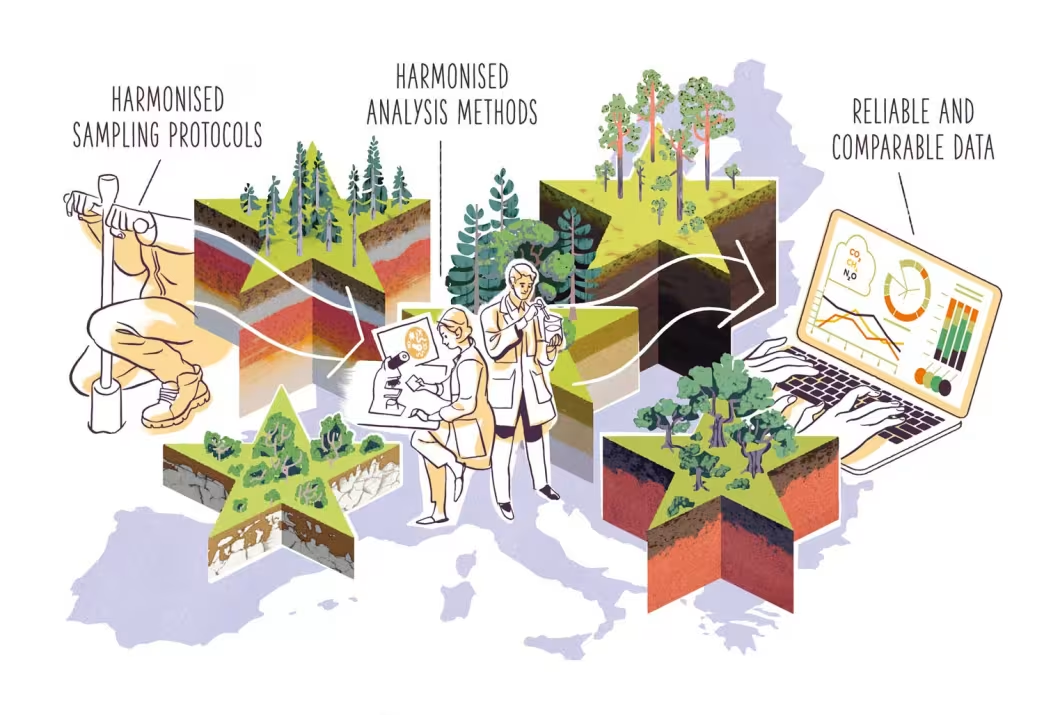
HoliSoils’ science-based, harmonised methodology facilitates comprehensive forest soil monitoring across Europe.
Photo by:
Graph by HoliSoils project.
A science-based harmonised methodology for forest soil monitoring
HoliSoils’ harmonised methodology facilitates comparability of forest soil monitoring data and findings across the EU. It contains carefully developed and tested protocols that build on earlier efforts to harmonise forest soil monitoring (e.g. ICP Forests and national soil surveys).
It includes protocols and techniques, including modern DNA-based methods, for biodiversity monitoring by means of quantification of microbial and faunal biomass and species composition, and for soil carbon stock assessment – making the following major contributions:
- Development and testing of a harmonised methodology to measure forest soil carbon fluxes and stock changes that can be used in national GHG inventories.
- Identification and testing of advanced soil models that are applicable to national GHG inventories.
- Development and testing of a harmonised methodology for the analyses of soil microbial and faunal communities.
What should policymakers do?
To meet the requirements of the EU Soil Monitoring Law and achieve its intended impact, EU and national-level policy makers should:
- Promote the adoption of the harmonised methodology proposed by HoliSoils for forest soil monitoring across all Member States.
- Promote the use of forest soil monitoring networks and protocols developed by HoliSoils that build on existing work and include DNA-based methodology to assess soil biodiversity.
- Ensure continuous dialogue with scientists and experts to access the latest scientific knowledge to enhance soil health.
HoliSoils’ harmonised methodology facilitates the EU-wide production of reliable and comparable soil data, including for forest soils, to guide the implementation of sustainable land management, the achievement of biodiversity conservation and climate policy objectives, and the continued provision of important ecosystem services. Grounded in interdisciplinary science, it supports evidence based decision-making in the EU.
Reference
Mäkipää, R., Ackermann, A., Adams, S., Bozzolan, N., Curiel, J., Guenet, B., Lehtonen, A., Santonja, M., Verkerk, P.J. 2025. How to advance the implementation of the EU Soil Monitoring Law? Policy Brief 14. European Forest Institute. https://doi.org/10.36333/pb14
This Policy Brief had been written in collaboration with HoliSoils – Holistic management practices, modelling and monitoring for European forest soils.
-

Jorge Curiel
Bertrand Guenet
Mathieu Santonja


Related content
How can we conserve primary and old-growth forests through the EU Nature Restoration Regulation?
The EU Nature Restoration Regulation could help conserve Europe's last primary and old-growth forests.
- Resilient forests
Forest Habitat monitoring in the context of Natura 2000
The ThinkForest event explored how forest habitat monitoring and assessment under the EU Habitats Directive can be improved to support more accurate,…
22 May 2026, 10:00–11:30
- Resilient forests
FOREST EUROPE releases report on The State of Europe’s Forests 2025
The State of Europe’s Forests 2025 report provides a comprehensive overview of the condition, management, and use of forest resources across Europe.
- Resilient forests