How to generate income from forests?
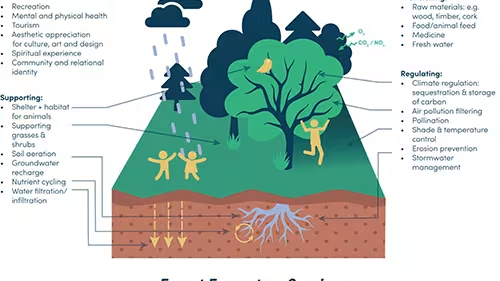
Europe has a long tradition of managing forests sustainably for wood production (McGrath et al., 2015). However, wood is far from being the only good that forests provide. People collect wild mushrooms and berries, while forests also contribute to soil erosion control, water purification, and carbon sequestration. Furthermore, research has shown that people value forests as beautiful places and important habitats for wild flora and fauna, enjoy forest-based recreation, and develop strong spiritual and cultural connections to forests. All these benefits that forests provide to society fall under the umbrella term forest ecosystem services (FES).
Modern forest management, as well as strategic EU policy documents, increasingly emphasises the need for forests to provide these services in a sustainable and balanced way. At the same time, however, forest management is fundamentally an economic activity and, regardless of whether the objective is to generate profit, it needs to be financed. Research by Lovrić et al. (2025) shows that approximately 80% of the funding for forest management in Europe comes from the sale of wood and timber, while only a much smaller share is generated through the provision of other ecosystem services.
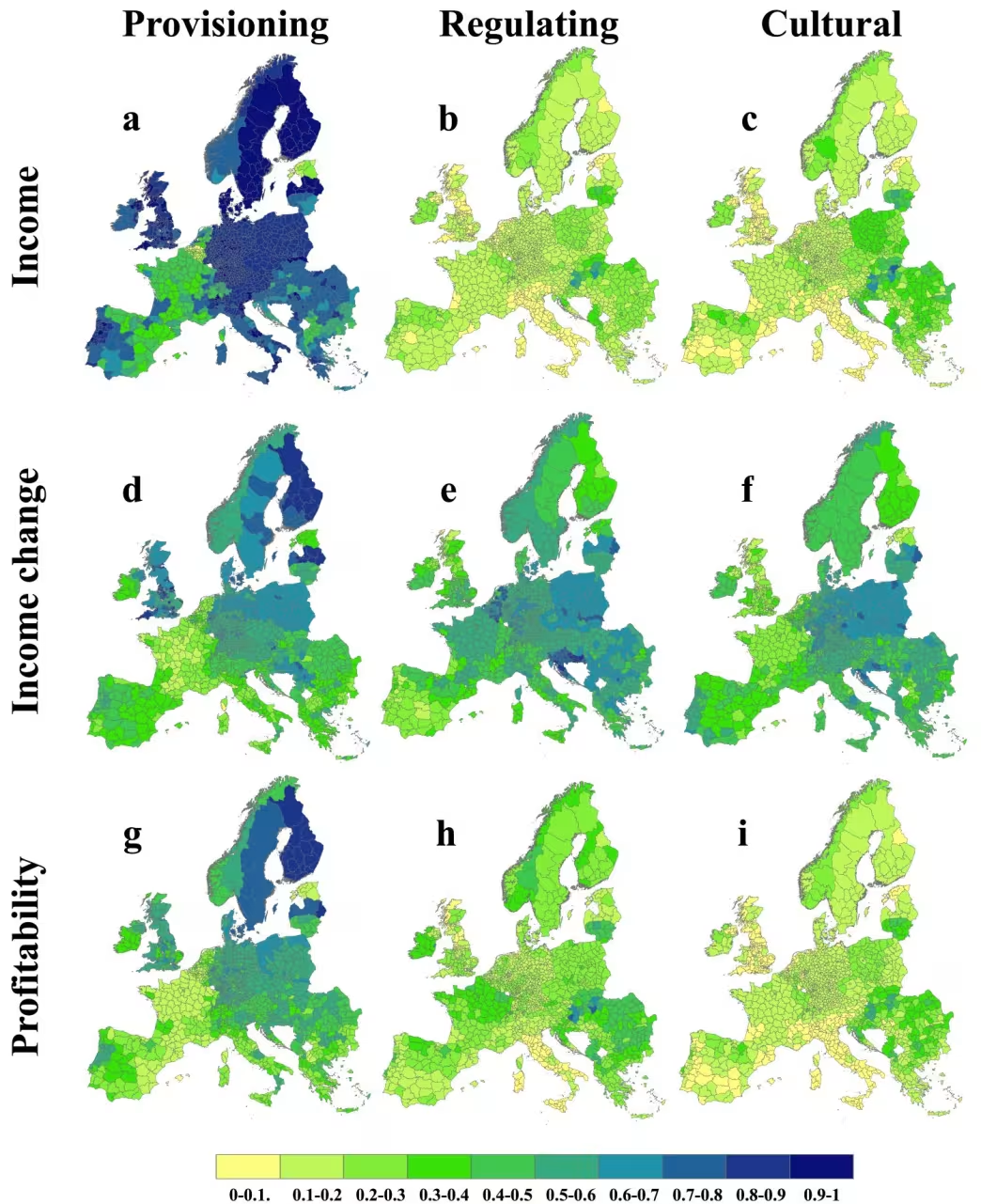
Figure 1. Share of forest income, income change and profitability. Columns represent provisioning (a, d, g), regulating (b, e, h) and cultural (c, f, i) FES. The first row (a, b, c) refers to share of forest income attributed to supplying each of the three FES groups (0 – ‘no income at all’ , 1 – ‘entire income from the forest’). The second row (d, e, f) refers to relative changes in forest income over the last 20 years (0 – ‘has strongly decreased’ , 1 – ‘has strongly increased’). The third row (g, h, i) refers to profitability of supplying different FES groups (0 – not at all’, 1 –very profitable’). Median values per NUTS3 region are presented.
Over the last 20 years, this situation has not changed significantly, despite policy instruments aimed at encouraging the provision of multiple ecosystem services. The costs of growing and harvesting timber can generally be covered by the revenues generated from timber sales. This is not the case, however, for many non-marketable forest ecosystem services, such as biodiversity conservation and forest-based recreation. This creates a fundamental challenge for European forest owners and managers. Public preferences, legislation, formal forestry objectives, and the professional values of forest managers increasingly point towards management systems that provide multiple ecosystem services. Economic incentives, however, often continue to favour the provision of wood.
This tension is particularly pronounced in Central and Northern Europe, where wood production is relatively profitable. In Southern and Eastern Europe, where timber production is generally less profitable, forest owners and managers receive alternative income from the provision of other ecosystem services, although to a much smaller extent. Higher levels of revenue and profitability from non-wood and non-timber ecosystem services are also found in state-owned forests than in privately owned forests.
How, then, can the financial sustainability of providing multiple forest ecosystem services be strengthened when the economic basis of forestry remains largely dependent on wood and timber?
There are several ways of addressing this mismatch, but a central element is the diversification of forest-based income sources. One positive example is Croatia, where a green tax provides financial support for the provision of ecosystem services such as biodiversity conservation, soil erosion control, fire prevention, and forest recreation. A similar approach can be found in Slovenia, where the state significantly subsidises activities that enhance the provision of these services. Another potential avenue is the development of new funding mechanisms under the EU’s Roadmap towards Nature Credits.
Payments for Ecosystem Services (PES) (Wunder, 2005) are also frequently discussed in this context. PES involve voluntary transactions between service users and service providers that are conditional on agreed natural resource management practices intended to generate ecosystem services. One example is the use of reverse auctions for biodiversity conservation in Central Jutland, Denmark. Under this scheme, forest owners and managers submit bids to a funding agency, in this case, the state, specifying the level of compensation they would require modifying or, in some cases, completely halt active forest management in order to achieve biodiversity conservation objectives.
At the same time, it is important to recognise that forest owners and managers are not motivated solely by financial considerations (Ficko and Boncina, 2013). The relationship between income and the provision of particular ecosystem services is therefore not necessarily direct. For example, private forest owners who live in urban areas, or who have inherited or purchased their forests, may not consider timber income to be the primary objective guiding forest management decisions. This highlights the importance of policies and interventions that recognise and strengthen the role of values, norms, and human–nature relationships in shaping forest management decisions.
Ultimately, addressing the mismatch between societal expectations, policy objectives, and the economic realities of forest management is likely to require a combination of policy instruments operating at different levels and involving both state and non-state actors (Winkel et al., 2022). Diversifying forest-based income streams can help create stronger financial incentives for the provision of non-market ecosystem services, while public funding, market-based mechanisms, and measures that recognise non-financial motivations can complement these efforts. A combination of such approaches is therefore needed to move European forestry towards a system in which the provision of multiple ecosystem services is not only expected, but also financially and institutionally supported.
References
McGrath, M.J., Luyssaert, S., Meyfroidt, P., Kaplan, J.O., Bürgi, M., Chen, Y., Erb, K., Gimmi, U., McInerney, D., Naudts, K., Otto, J. 2015. Reconstructing European forest management from 1600 to 2010. Biogeosciences, 12(14), 4291–4316. https://doi.org/10.5194/bg-12-4291-2015
Lovrić, M., Torralba, M., Orsi, F., Pettenella, D., Mann, C., Geneletti, D., Plieninger, T., Primmer, E., Hernandez-Morcillo, M., Thorsen, B.J., Lundhede, T. 2025. Mind the income gap: Income from wood production exceed income from providing diverse ecosystem services from Europe’s forests. Ecosystem Services, 71, 101689. https://doi.org/10.1016/j.ecoser.2024.101689
Wunder, S. 2005. Payments for environmental services: some nuts and bolts (Vol. 42, pp. 1-32). Bogor, Indonesia: Cifor.
Ficko, A., Boncina, A. 2013. Probabilistic typology of management decision making in private forest properties. Forest Policy and Economics 27, 34–43 https://doi.org/10.1016/j.forpol.2012.11.001
Winkel, G., Lovrić, M., Muys, B., Katila, P., Lundhede, T., Pecurul, M., Pettenella, D., Pipart, N., Plieninger, T., Prokofieva, I., Parra, C. 2022. Governing Europe's forests for multiple ecosystem services: Opportunities, challenges, and policy options. Forest Policy and Economics, 145, p.102849. https://doi.org/10.1016/j.forpol.2022.102849
-

Georg Winkel
Related content
What do people think about forests in the EU?
FInd out people's perceptions of different forest ecosystem services in the EU.
- Forests and people

What are non-wood forest products?
Non-wood forest products include berries, mushrooms, medicinal and decorative plants, nuts, resins, game, and wild honey.
- Forests and people
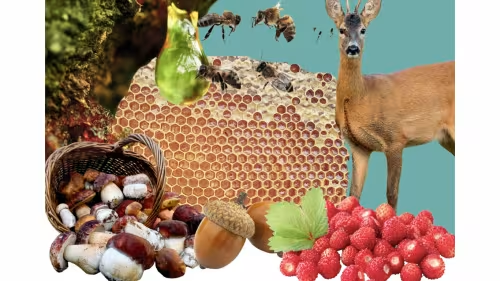
What are ecosystem services?
Ecosystem services refer to the benefits humans derive over time from natural or near-natural systems and processes.
- Forests and people