How to govern Europe’s forests for multiple Forest Ecosystem Services?

Photo by:
Photo by Ivan Kmit / AdobeStock
Four policy pathways to align forest ecosystem services provision & demand…
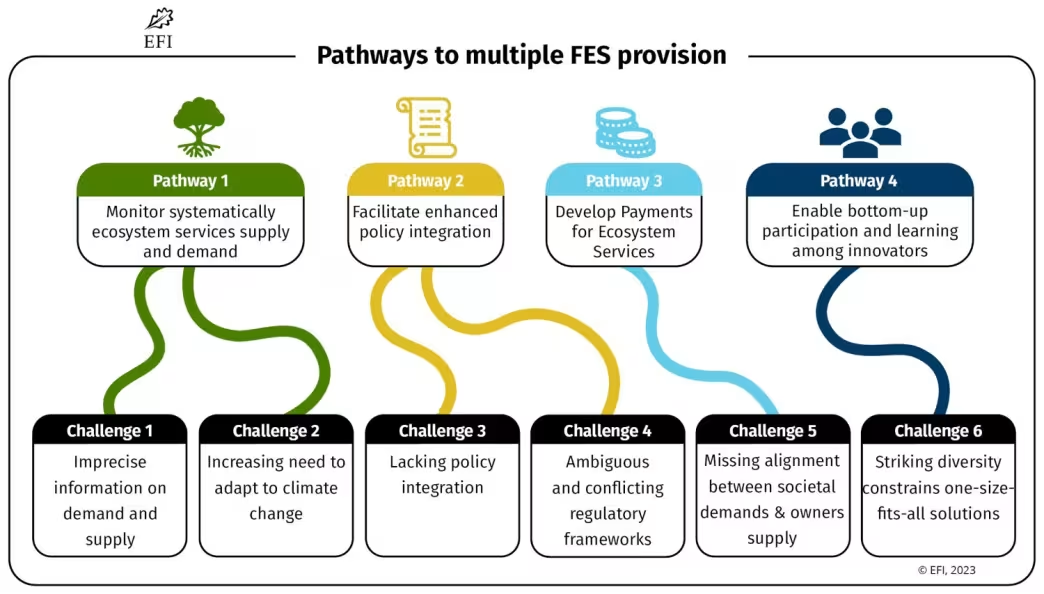
Europe’s forests provide multiple forest ecosystem services (FES) including wood, carbon sequestration, habitats, and nature for recreation. The EU Green Deal gives strong momentum for a future European forest policy to incentivise the provision of multiple FES. Four policy pathways can translate this momentum into action:
Pathway 1: Monitor systematically ecosystem services supply and demand: Combine monitoring technologies (e.g. remote sensing, national forest inventories, citizen science approaches) to compile spatially explicit data on both ecosystem services supply and demand that is meaningful for policymakers, society and forest owners, and monitor developments over time.
Pathway 2: Facilitate enhanced policy integration: Manage the diversity of worldviews and related interests towards forests by a) giving all forest-related societal groups access to the policy-making process, b) aligning agreed policy objectives with policy instruments, c) monitoring policy implementation, and d) adopting policies accordingly.
Pathway 3: Develop Payments for Ecosystem Services (PES): Consider establishing a forest-focused European PES system characterized by a) a focus on key priority ecosystem services, b) stable (public/ private) finance sources, e.g. by redirecting money, c) space for innovative designs – e.g. reverse auctions, d) priority areas such as landscapes with high potential for ecosystem services provision or high societal demand, and e) a long-term commitment plus monitoring and compliance mechanisms.
Pathway 4: Enable bottom-up participation and learning among innovators: Facilitate participatory, bottom-up processes at regional/local levels to map priorities and identify potential conflicts. Use transnational networking to enhance learning among forest owners and managers developing ecosystem services-related innovations.
…because we face six challenges for Forest Ecosystem Services
- Imprecise information on demand and supply: Information on forest ecosystem services has improved in recent decades, but still mostly focuses on wood production, especially at local or regional levels. There is no systematic information on societal demands on forest ecosystem services in Europe.
- Increasing pressure to adapt to climate change: Climate change is increasingly impacting on Europe’s forests and adaptation is imperative, which leads to new threats and opportunities for ecosystem services provision.
- Lacking policy integration: There is a tendency towards polarisation in EU forest policy between environmental/conservation concerns and forest use interests, resulting in disputes about competences. This inhibits compromise seeking, and the development of effective policy mixes for multiple forest ecosystem services.
- Ambiguous regulatory frameworks: Conflicting interests translate into ambiguous and partially conflicting regulatory frameworks. These go along with strikingly different assignments of property rights across countries and may constrain forest owners’ possibilities to innovate supply.
- Missing alignment of supply and societal demand: Society prioritizes forests as habitats for species or places for nature recreation, but forest owners generate most income from wood.
- Striking diversity constrains one-size-fits-all solutions: Forests and forest management practices are highly diverse across Europe, for instance with significant regional variations between wood harvesting intensities or forest-related risks such as fire. This underlines the necessity to translate European policy frameworks into regionally adapted forest policy mixes.
Reference
Winkel, G., Lovrić, M., Muys, B., Katila, P., Lundhede, T., Pecurul, M., Pettenella, D., Pipart, N., Plieninger, T., Prokofieva, I., Parra, C., Pülzl, H., Roitsch, D., Roux, J-L., Thorsen, B.J., Tyrväinen, L., Torralba, M., Vacik,H., Weiss, G., Wunder, S.. 2023. How to govern Europe’s forests for multiple Forest Ecosystem Services? Policy Brief 3. European Forest Institute. https://doi.org/10.36333/pb3
Further reading: Further reading:
Winkel et al. 2022. Governing Europe's forests for multiple ecosystem services: Opportunities, challenges, and policy options. Forest Policy and Economics, 145, 102849. https://doi.org/10.1016/j.forpol.2022.102849
-
Georg Winkel

Nathalie Pipart
Irina Prokofieva
Mario Torralba



Related content
A global analysis of key design factors for sustainable payment for ecosystem services schemes
This review intends to assist PES designers and policy and decision-makers in developing PES schemes better tailored to contemporary challenges and…
- Forests and people

Recommendations for better integrating payment schemes for forest ecosystem services into EU policies
Why is uptake of forest payments for ecosystem services still low in Europe? Few measures, limited enrolment and insufficient incentives.
- Inclusive governance
Matching the supply and demand of forest ecosystem services in Europe
We aim to identify the main challenges in quantitatively mapping and modelling forest ecosystem services (FES) supply-demand mismatches.
- Forests and people