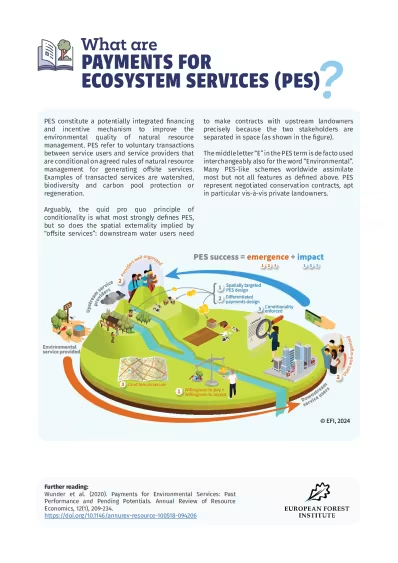
PES constitute a potentially integrated financing and incentive mechanism to improve the environmental quality of natural resource management. PES refer to voluntary transactions between service users and service providers that are conditional on agreed rules of natural resource management for generating offsite services. Examples of transacted services are watershed,
biodiversity and carbon pool protection or regeneration.
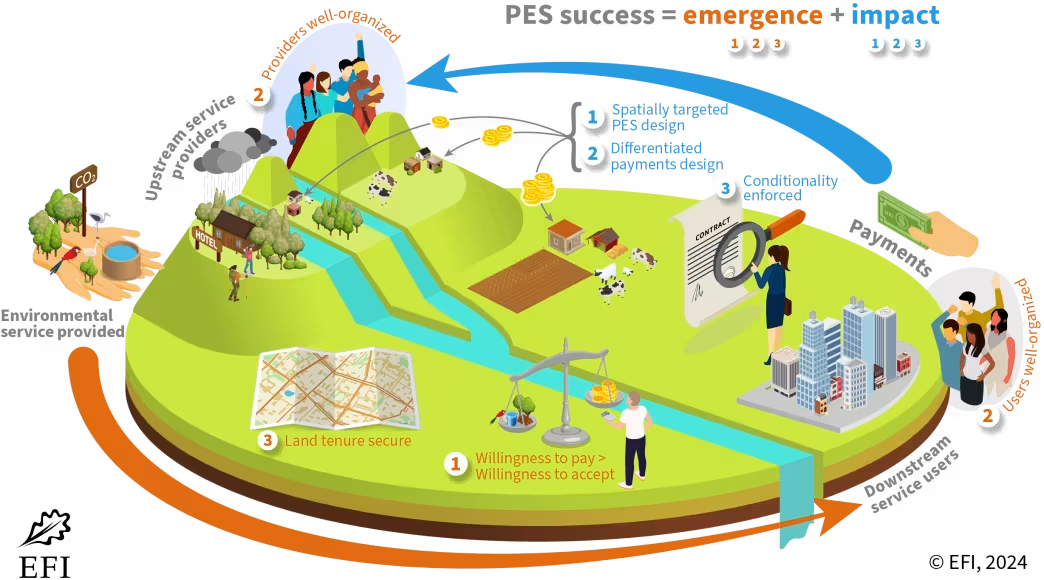
Arguably, the quid pro quo principle of conditionality is what most strongly defines PES, but so does the spatial externality implied by “offsite services”: downstream water users need to make contracts with upstream landowners precisely because the two stakeholders are separated in space (as shown in the figure).
The middle letter “E” in the PES term is de facto used interchangeably also for the word “Environmental”. Many PES-like schemes worldwide assimilate most but not all features as defined above. PES represent negotiated conservation contracts, apt in particular vis-à-vis private landowners.
Further reading
Wunder et al. (2020). Payments for Environmental Services: Past Performance and Pending Potentials. Annual Review of Resource Economics, 12(1), 209-234. https://doi.org/10.1146/annurev-resource-100518-094206

Related content
What is forest bioeconomy?
Forest bioeconomy promotes resilient, circular and climate-smart forestry within ecological boundaries and for wellbeing.
- Sustainable economy
INTERCEDE
Incentivising future forest ecosystem services and incomes in Europe
- Sustainable economy

Session ecosystem services assessment and biodiversity footprinting at SETAC Europe 27th LCA Symposium
Anyone working on ecosystem services, biodiversity metrics, LCA, or sustainability assessment in bio‑based value chains is invited to join.
18 October 2026 – 21 October 2026
- Sustainable economy