From regional action to scaling solutions: EFI at the Global Bioeconomy Summit 2026
At the Global Bioeconomy Summit 2026 in Dublin, EFI organised and co-led two workshops exploring how the bioeconomy can move from ambition to implementation, from the role of regions in driving the transition to the question of which forest-based solutions should be scaled.
The Global Bioeconomy Summit (GBS), held in Dublin on 19–21 October, brought together the global bioeconomy community to discuss how the bioeconomy can contribute to more sustainable and resilient economies. EFI’s contributions looked at the same challenge from two complementary angles: what regions need to put the bioeconomy into practice, and what is needed to move promising forest-based innovations towards wider uptake.
Regions at the forefront of the bioeconomy transition
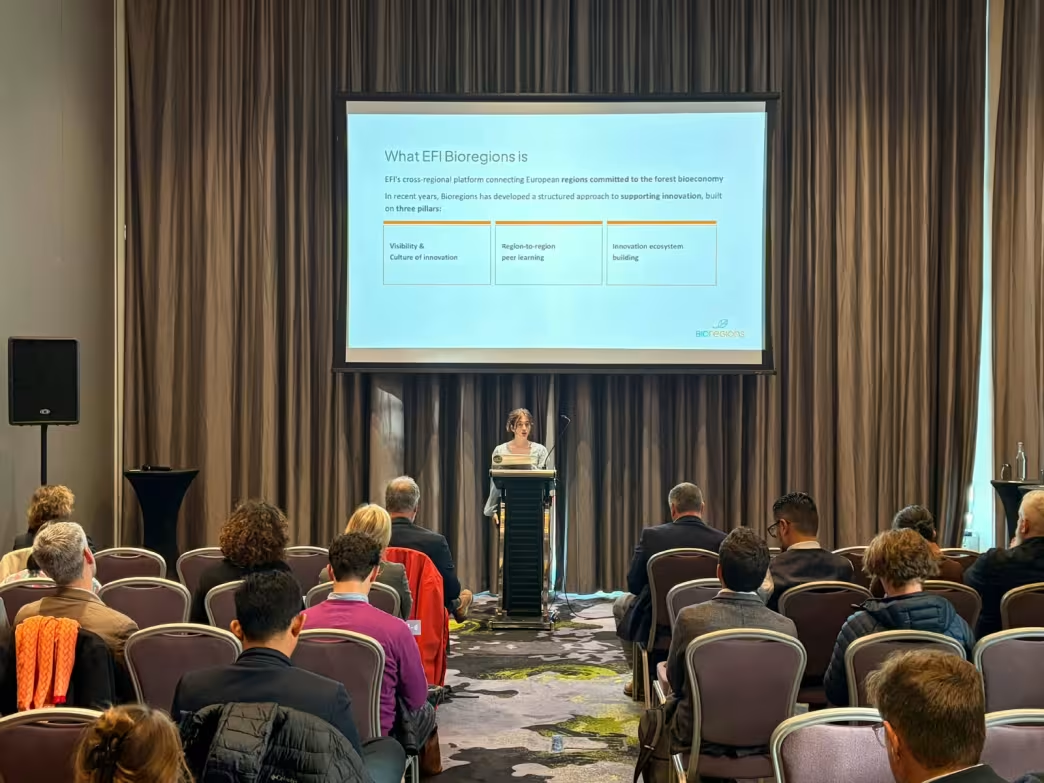
Lia Sweetman de Clar (EFI) presenting Bioregions’ work.
On 19 October, EFI Bioregions and the Horizon Europe BIO2REG project co-organised Regional Bioeconomy in Action: From Local Solutions to Global Transformation, an official GBS satellite event. The event brought together regional policymakers, practitioners and researchers to exchange experiences, learn from each other and explore future collaboration. It also marked the final public event of BIO2REG.
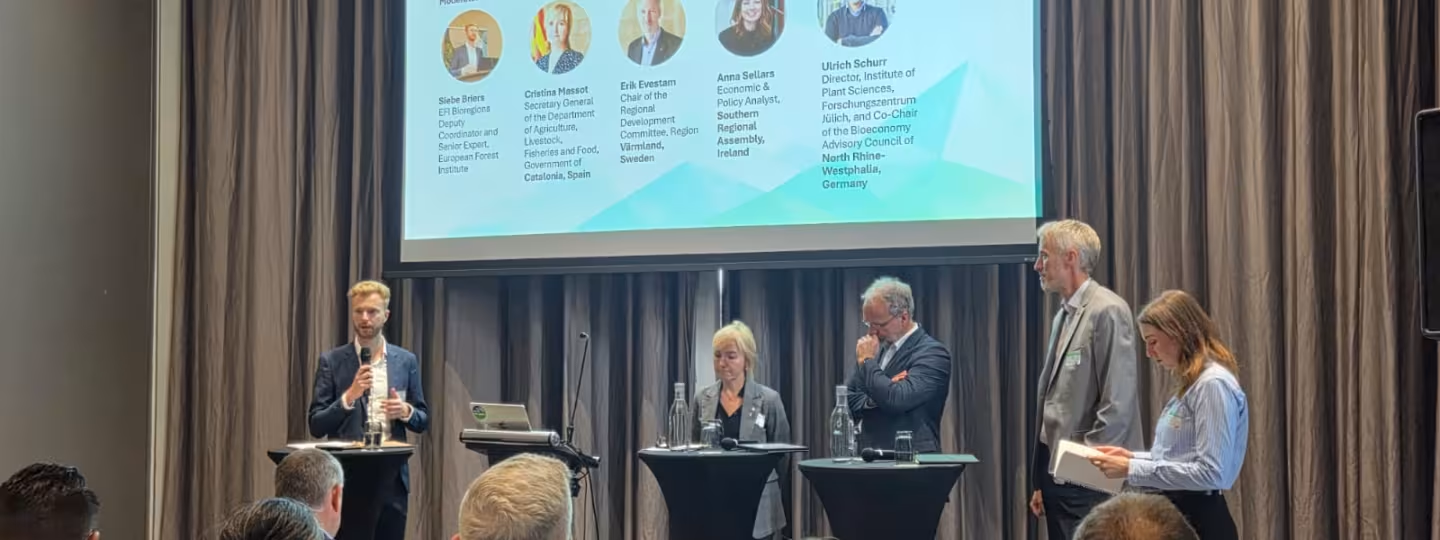
Siebe Briers (EFI) moderated a high-level roundtable on regional pathways to the bioeconomy, with Cristina Massot (Secretary General of the Department of Agriculture, Livestock, Fisheries and Food, Government of Catalonia, Spain), Erik Evestam (Chair of the Regional Development Committee, Region Värmland, Sweden), Anna Sellars (Economic & Policy Analyst, Southern Regional Assembly, Ireland) and Ulrich Schurr (Director, Institute of Plant Sciences, Forschungszentrum Jülich, and Co-Chair of the Bioeconomy Advisory Council of North Rhine-Westphalia, Germany).
The panellists agreed that regions are a crucial level of governance, close enough to local realities to turn bioeconomy strategies into concrete action. They stressed that the bioeconomy needs to be more than a research and policy concept: primary producers, biomass processing industries and civil society must feel part of it and see its benefits. In this respect, seeing is believing. Demonstrating that the bioeconomy delivers results is what allows other regions to learn from and replicate proven success stories.
A second session turned to practical implementation instruments from regions in Europe and beyond. Lia Sweetman de Clar (EFI) presented Bioregions’ work on financing, scaling and resource mobilisation for forest bioeconomy innovation. She outlined how the platform supports innovators at three points where their journey from lab to market often stalls: building demand for bio-based solutions, connecting innovators with partners and investors across regions, and strengthening their investment readiness, for example through the Forest Bioeconomy Investment Accelerator with the EIB Group taking place on 25 November 2026. Other pitches covered regional cluster approaches, peer learning, shared forest data infrastructure and industry-led models from Germany, Ireland, the Basque Country and Costa Rica.
Forests in the Bioeconomy: Building Integrated Pathways Across Sectors and Regions
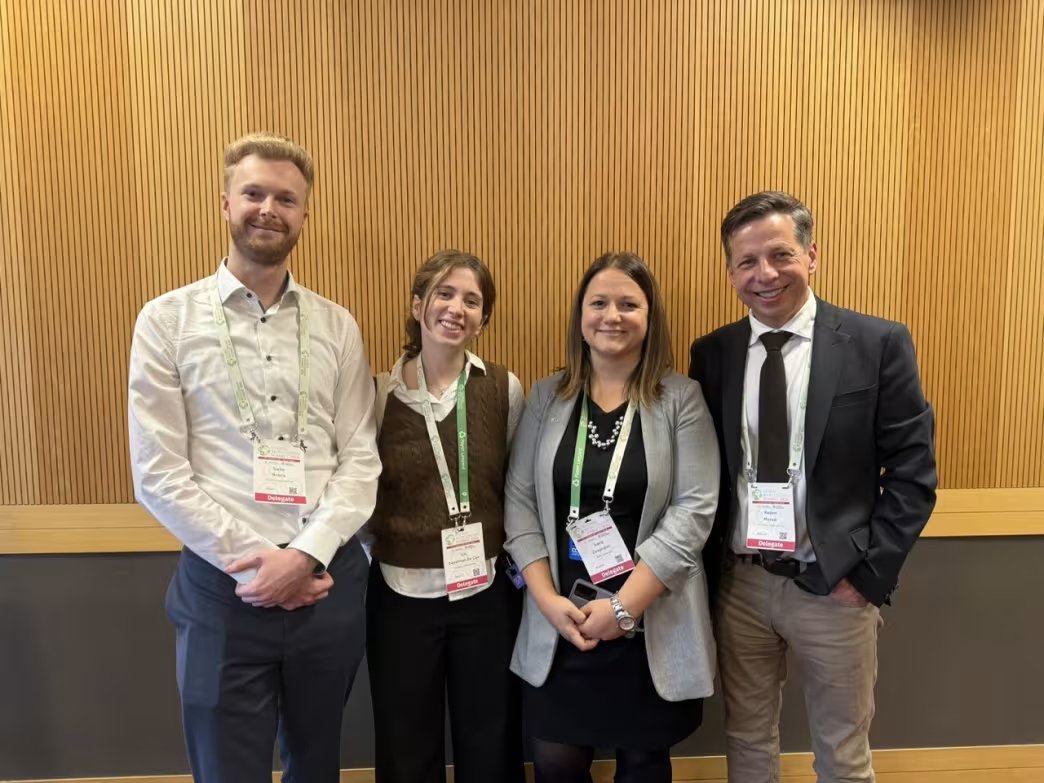
From left to right: Siebe Briers (EFI), Lia Sweetman de Clar (EFI), Ivana Zivojinovic (BOKU University), and Robert Mavsar (EFI).
On 20 October, EFI co-organised the workshop Forests in the Bioeconomy: Building Integrated Pathways Across Sectors and Regions. The workshop explored how forest resources can deliver greater value across competing bioeconomy uses while respecting ecological limits and regional realities.
The discussion centred on an increasingly important question for the forest-based bioeconomy: not only how to scale innovative solutions, but which ones should be scaled, why, and under what conditions. Opening speakers from the University of Galway, the European Investment Bank and the EU Bioeconomy Youth Ambassadors set the scene. They challenged participants to recognise that not every forest innovation is worth scaling, and to ask who actually benefits from the value forests create.
A fishbowl discussion followed and drew in participants from across Europe, Africa, Asia and Latin America. Their contributions showed how differently the same questions play out across regions. Some speakers stressed that forest resources have limits and that rising demand for biomass can put pressure on both ecosystems and local communities.
Others shared practical models, from a Finnish forest-owner cooperative exemplifying how forest owners can pool their interests to ensure benefits return to its members, to Ghanaian cooperation between forestry, agriculture and energy. Participants also stressed that scaling must be fair, raising issues such as land tenure, youth employment and the role of Indigenous people in deciding who benefits from new forest-based value chains.
In his closing reflections, Robert Mavsar (EFI) drew these threads together around trust and mutual learning. Ultimately, scaling the forest-based bioeconomy is less about applying the same solutions everywhere and more about understanding what works in different contexts, and allowing approaches to evolve in response to local priorities and opportunities.
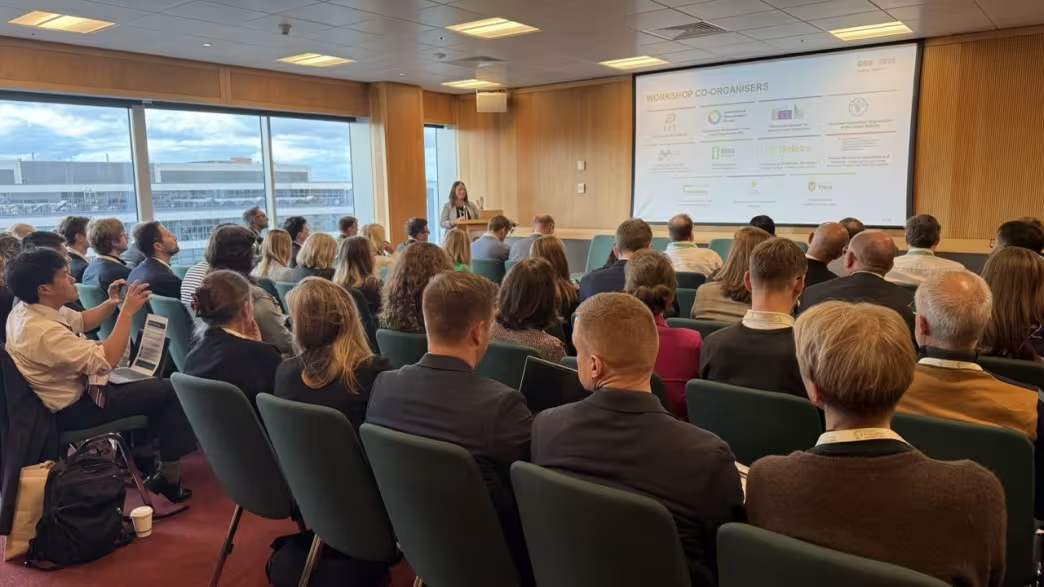
Ivana Zivojinovic (BOKU University).
Related content
Meet the future leaders of forest innovation: YLP 2026 participants
Young professionals worldwide gather in Joensuu, Finland, to explore futures thinking, innovation and the forest bioeconomy.
- Forests and people
How to measure your impact on nature: CircHive launches biodiversity footprinting guidance and decision tree
CircHive launches two resources to help organisations understand and measure their impact on nature.
- Forests and people
New report on the role of artists in woodland creation
Practice and policy recommendations for the creation and governance of living forest-artworks.
- Forests and people