Malaysia Smallholder Project
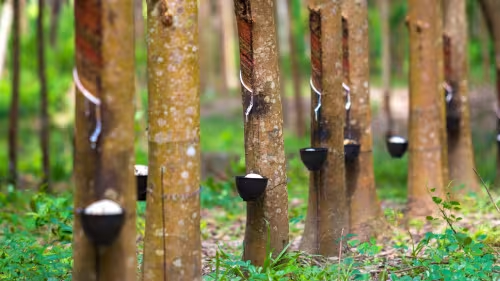
Malaysia is the world’s second largest producer of palm oil, and rubber is also an important economic commodity. Both the palm oil and rubber sectors rely on substantial numbers of smallholder producers, supporting rural communities and livelihoods. Global markets and consumers are increasingly demanding evidence that these commodities are produced legally and without causing deforestation, requiring greater support to ensure smallholders are not excluded from high-value international supply chains.
Our objective: improving the livelihoods of rubber and palm oil smallholders through increased global market access
Targeting the rubber and palm oil sectors, this project works to broaden smallholder producers’ access to supply chains serving global markets, particularly in the context of the EU Deforestation Regulation (EUDR). Our work also aims to improve smallholders’ livelihoods by supporting existing national strategies and processes, and ensuring smallholders are able to provide information related to traceability, deforestation-free production and legality.
Our work: strengthening systems, enhancing information collection, and piloting models for smallholder inclusion
Under the project, we work with government agencies, cooperatives, industry associations, civil society, and the private sector to increase awareness of global market information requirements and ensure national systems are equipped to provide this information in relation to smallholders.
Through pilot projects in the three regions of Malaysia – Peninsular Malaysia, Sabah, and Sarawak – the project is testing different methods for smallholder inclusion, support increased traceability, and ensure smallholders and other supply chain actors are prepared to collect EUDR-relevant data on legality and deforestation-free production.
The project is funded by the EU Delegation to Thailand and runs from January 2025 – June 2027. Work is implemented in collaboration with the EU Delegations to Malaysia and Thailand and the Malaysian Ministry of Plantation and Commodities.
For the palm oil sector, the project focuses on smallholder producers, intermediaries, and independent mills involved in EU supply chains. Activities will support the Malaysian Sustainable Palm Oil (MSPO) certification scheme to close gaps in EUDR information availability; develop and pilot models for enhancing smallholder livelihoods through public and private sector initiatives; and facilitating sector dialogues.
For the rubber sector, we are piloting a smallholder clustering model; enhance the capacity of mid-stream small- and medium-sized enterprises (SMEs) to collect and transfer EUDR-relevant information; increase awareness of the Malaysian Sustainable Natural Rubber (MSNR) framework and how it gathers EUDR-relevant information; and improve cross-border traceability and information sharing.
Featured experts

Communications contact

Related content
EU Deforestation Regulation: Early responses in producer countries
Early evidence shows how producer countries are adapting to the EU Deforestation Regulation through traceability, legal reviews, and coordination.
- Inclusive governance
KAMI
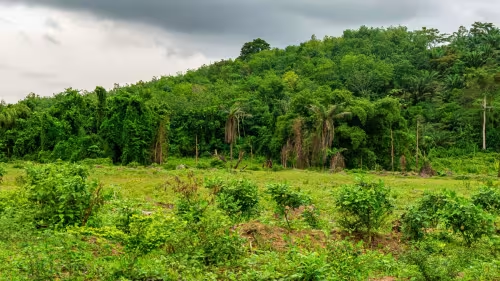
The KAMI project provided support for dialogue between EU, Malaysian and Indonesian stakeholders on the sustainability of the palm oil value chain.
- Inclusive governance
Thai Smallholder Rubber Project
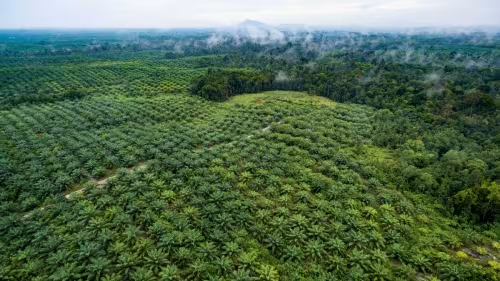
We support smallholder rubber producers in Thailand to improve agricultural and environmental practices and strengthen value‑chain management.
- Inclusive governance