
EFI Council adopts new Policy Framework and reinforces impact focus
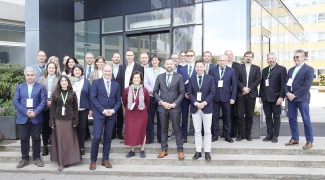
The EFI Council adopted a revised Policy Framework and set a course for a more focused and impact-driven organisation at its meeting in Prague, Czechia, on 23–24 April. The session brought together representatives of EFI Member Countries to take stock of recent developments and agree on priorities for the coming period.
The meeting was the 8th ordinary session of the EFI Council, EFI’s highest decision-making body. Composed of Member Countries, the Council sets the organisation’s overall direction, approves key frameworks and decisions, and oversees its governance. Ordinary sessions take place every three years.
EFI development and outlook
The Council was presented with an overview of EFI’s development since the previous meeting, highlighting strong growth in research activities, policy support, and international engagement, alongside an increasing global dimension of EFI’s work. Discussion was held on consolidating and focusing activities, with a stronger emphasis on Member Country needs and more effective use of the EFI network. The outlook indicates a transition towards a more focused, connected and impact-driven EFI.
Policy Framework
A central outcome of the meeting was the adoption of a revised EFI Policy Framework. The updated framework reaffirms EFI’s role as a platform connecting knowledge, policy, practice and society, and ensures that the organisation remains fit for purpose in a rapidly evolving context.
The revised framework maintains EFI’s mandate while clarifying its core functions. It strengthens the organisation’s role in providing independent, robust and credible knowledge, enhancing cooperation across European forest expertise, facilitating dialogue and co-creation, supporting policy development and implementation, and raising awareness of the value of forests. The revision emphasises coherence and coordination across national, European, and international efforts.
Council governance
The Council confirmed future leadership proposals, electing Switzerland to hold the Chair for 2026–2029, followed by Germany for 2029–2032.
The meeting marked the conclusion of the Czech Presidency, with appreciation expressed for its leadership and contribution during this period.
Board membership
The Council elected a new Board member, Prof. Tuula Packalen (Finland). She serves as Research Professor in forest planning at the Natural Resources Institute Finland (LUKE) and has extensive experience in both research and public administration. Her previous roles include Director-General at the Finnish Ministry of Agriculture and Forestry and Programme Director and Research Manager at LUKE. She brings prior experience from EFI, where she served as Head of Programme, Foresight and Information.
The Council also re-elected three Board members: Prof. Robert Marušák, Prof. Elena Paoletti and Prof. Verena Griess.
Focus on forest disturbances
A second key focus of the session was the increasing scale and intensity of forest disturbances across Europe. Member Countries and experts exchanged scientific insights and national experiences, highlighting growing pressures linked to climate change and other drivers.
Discussions highlighted the need for coordinated, evidence-based responses, as well as strengthened resilience and adaptive management. The importance of knowledge exchange and cooperation across the EFI network was emphasised.
The next (9th) ordinary session of the EFI Council will be held in Switzerland in 2029.
Photo by Julie Bartošová, DiS., Faculty of Forestry and Wood Sciences | Czech University of Life Sciences