
Photo by:
Photo by Szymon Bartosz / AdobeStock
Biodiversity remains under continuous long-term decline, and a significant funding gap estimated at USD 700 to 900 billion per year is limiting efforts to reverse this trend. Biodiversity credits have emerged as one potential mechanism to mobilise private finance by providing compensation for measurable and additional biodiversity gains, both through its protection (“avoided loss”) and restoration (“uplift”). While drawing from the design of carbon credits and biodiversity offsets, biodiversity credits also risk replicating some of their shortcomings. If past market design and implementation flaws are repeated, the credibility and impact of biodiversity credits could be seriously undermined.
At present, the emerging biodiversity credit market is characterised by a diverse and uncoordinated landscape, with multiple methodologies and indicators being developed and promoted. However, the fast-growing number of approaches and broad interest may be moving quicker than the development of clear concepts, leading to confusion about quality, consistency, and impact.
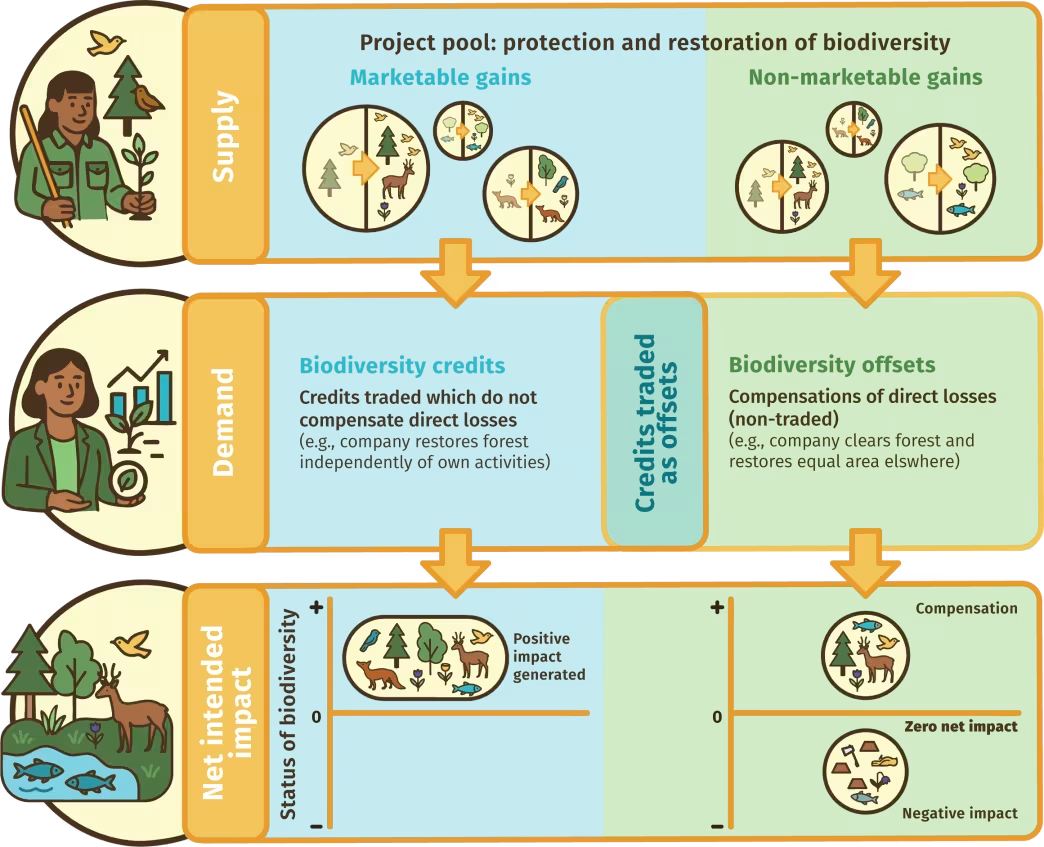
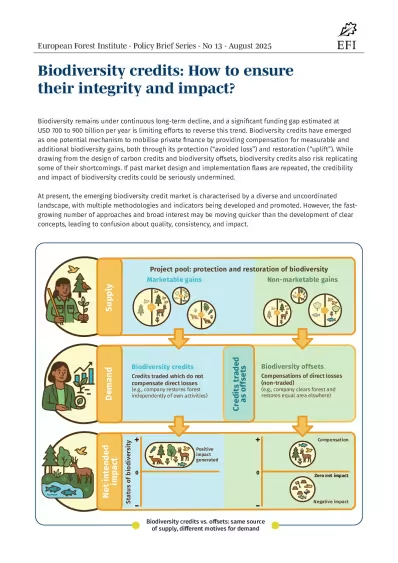
Biodiversity credits vs. offsets: same source of supply, different motives for demand
Four critical challenges are evident:
1. Commensurability: Given the complexity of nature, no single and universally interchangeable biodiversity unit comparable to CO₂ equivalents in the carbon market exists. A blend of metrics is in use, often focusing on key species and habitats. These may provide an incomplete picture or even facilitate manipulation if implementers were to ex post cherry-pick indicators.
2. Baselines and additionality: Many schemes use vague, or overly flexible baselines – a key weakness in voluntary carbon and offset markets. Current indicators often reflect actions or uncertain projections rather than a clear outcome. This can incentivize inflated baselines and non-additional “hot-air” credits with poor value for money.
3. Permanence and leakage: Ensuring long lasting biodiversity gains (permanence) and avoiding displacement threats (leakage) remain difficult to monitor and rarely fully achievable. Lessons from carbon markets show the need to assess and address losses over time and space through measures like buffer pools and tailored actions.
4. Governance and integrity: The emerging credits market lacks strong standards, transparency, and independent oversight. This can enable private certifiers to prioritize volume over quality, while institutional weaknesses may undermine outcomes and social equity concerns. Overly cheap credits may incentivise a race to the bottom.
What can key decision-makers do?
a. Policymakers should help set transparent future minimum standards and support monitoring systems, including social safeguards.
b. Corporate decision-makers should assist in adopting high-integrity market standards, being transparent, stable, and ecologically robust.
c. Donors should systemically invest in and cofund public-goods, including by de-risking innovative, scalable approaches when other public support is limited.
d. Civil society (e.g., NGOs, multilaterals) can use science-based evidence to represent the environment at the negotiation table, supporting both ecological integrity and social safeguards.
e. Bankers may need to bridge future financing gaps and buffer time lags between upfront actions and ex-post, outcome-evaluated credits.
f. Project developers should adopt robust crediting methodologies, and use scientifically sound, outcome-based counterfactuals with third-party verification.
g. Researchers can help measure biodiversity, improve credits baselines, and undertake rigorous impact evaluation enabling adaptive management.
Reference
Wunder, S. and Fraccaroli, C. 2025. Biodiversity credits: How to ensure their integrity and impact? Policy Brief 13. European Forest Institute. https://doi.org/10.36333/pb13
This Policy Brief had been written in collaboration with SUPERB (Systemic solutions for upscaling of urgent ecosystem restoration for forest-related biodiversity and ecosystem services)
Recommended reading: Wunder, S., C. Fraccaroli, J. Bull, et al. 2025. “Biodiversity Credits: An Overview of the Current State, Future Opportunities, and Potential Pitfalls.” Business Strategy and the Environment 1–30. https://doi.org/10.1002/bse.70018


Related content
- Resilient forests

How can we conserve primary and old-growth forests through the EU Nature Restoration Regulation?
The EU Nature Restoration Regulation could help conserve Europe's last primary and old-growth forests.
- Resilient forests

Forest resilience and disturbance: What role does biodiversity play?
This brief shares insights as to what policymakers and forest managers can do to enhance biodiversity.
- Resilient forests