Integrated Fire Management – empowering action for a fire-resilient Europe
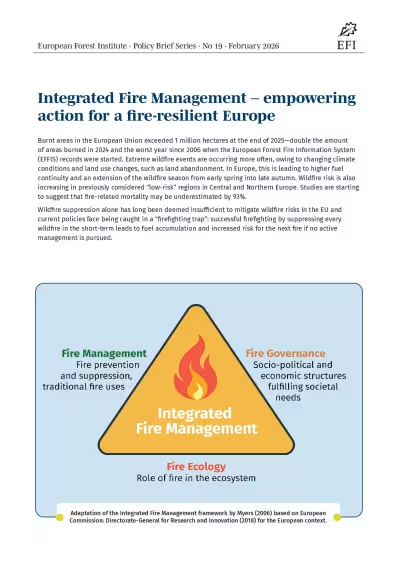
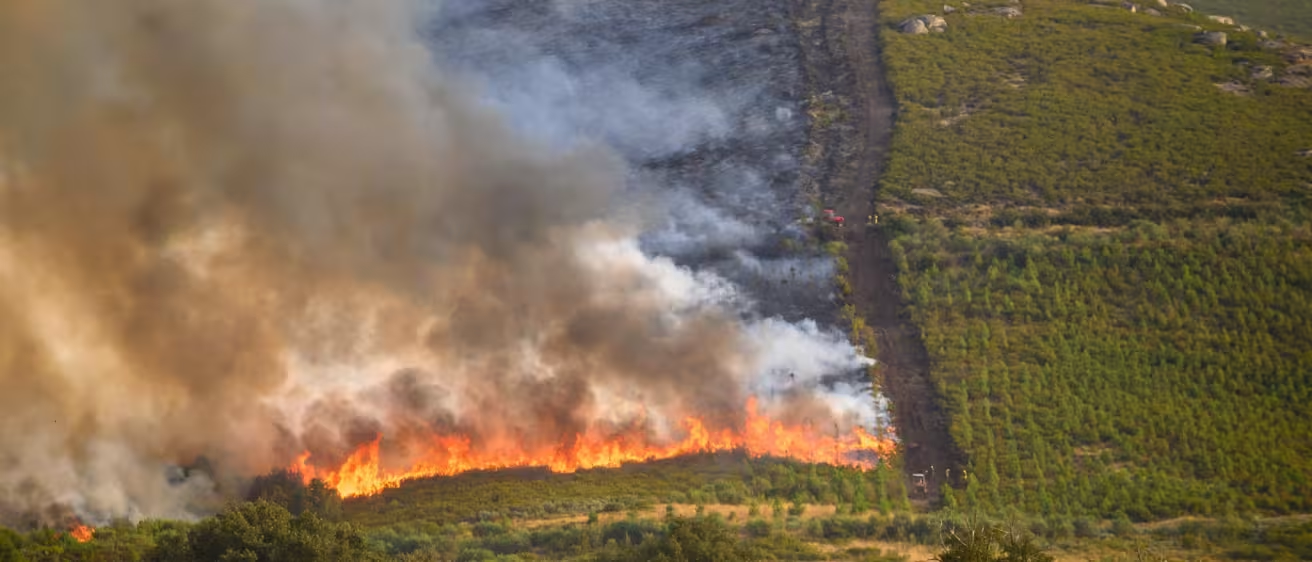
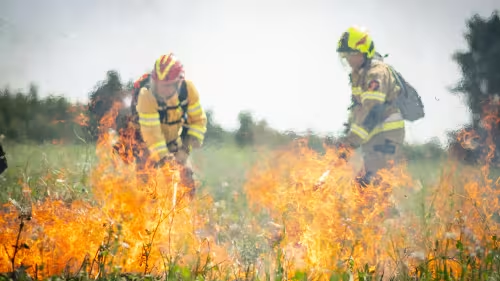
A controlled burn with a fire lane.
Photo by:
Burnt areas in the European Union exceeded 1 million hectares at the end of 2025—double the amount of areas burned in 2024 and the worst year since 2006 when the European Forest Fire Information System (EFFIS) records were started. Extreme wildfire events are occurring more often, owing to changing climate conditions and land use changes, such as land abandonment. In Europe, this is leading to higher fuel continuity and an extension of the wildfire season from early spring into late autumn. Wildfire risk is also increasing in previously considered “low-risk” regions in Central and Northern Europe. Studies are starting to suggest that fire-related mortality may be underestimated by 93%.
Wildfire suppression alone has long been deemed insufficient to mitigate wildfire risks in the EU and current policies face being caught in a “firefighting trap”: successful firefighting by suppressing every wildfire in the short-term leads to fuel accumulation and increased risk for the next fire if no active management is pursued.
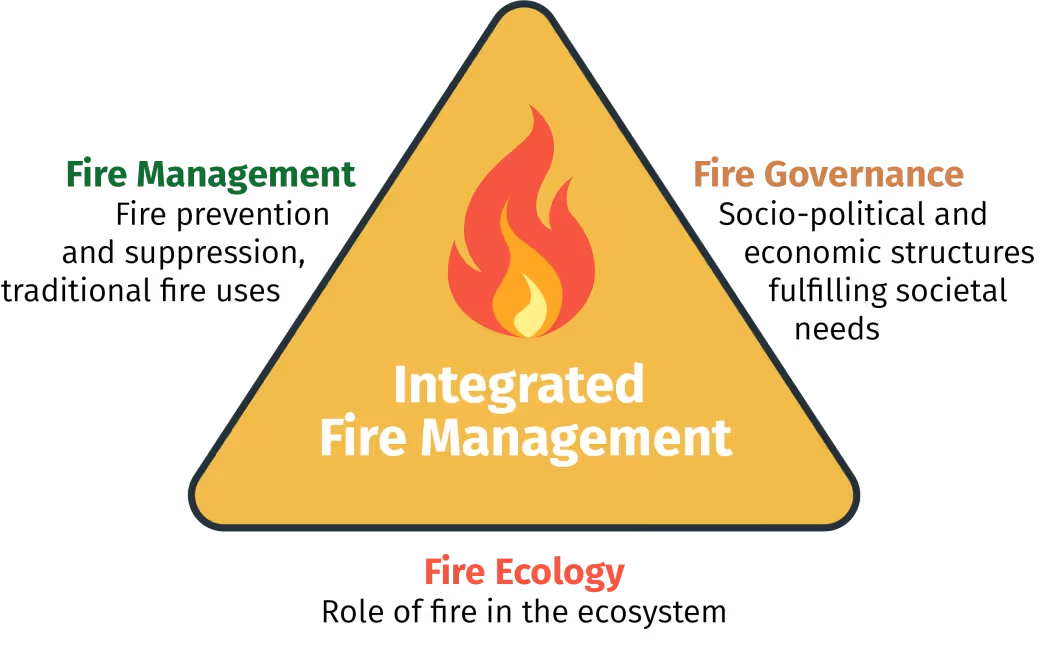
Adaptation of the Integrated Fire Management framework by Myers (2006) based on European Commission: Directorate-General for Research and Innovation (2018) for the European context.
To safeguard the future, a shift from reactive response to an Integrated Fire Management is important. This approach understands wildfire as a land management and societal challenge rather than treating it as just another emergency. It integrates three main aspects: wildfire management (including prevention, suppression and fire use); wildfire ecology (focusing on the role of fire in the ecosystem); and wildfire governance (also referred to as culture, which considers both the socio-economic and cultural imperatives of fire use along with the negative impacts that fire can have on society).
Responsible citizen action and fire-use capacity remain key. Before reshaping landscapes, the socio-cultural relationship with fire needs to be reshaped in Europe, as resilience starts with empowered and educated citizens. Bottom-up participation schemes can offer to bridge knowledge gaps and build local social capital, ensuring communities can manage their own defensible spaces. Public awareness is needed on why prescribed burning can help to prevent catastrophic wildfires. In addition, nature-based solutions can support managing wildfires as they promote long-term ecological health and a stable forest microclimate.
What policymakers should consider doing?
At the European level
1. Innovation in governance and funding
- Harmonise sectoral policies: systematically assess sectoral policies (CAP, Cohesion, LIFE) to ensure e.g. afforestation and other land-use goals do not inadvertently increase wildfire risks, and develop an EU Framework for adaptive fire use.
- Unified responsibility: bridge the gap between disaster risk management and environmental protection by developing an integrated policy that addresses societal, ecological, and risk challenges together across levels of competences.
- Establish an easy-access fire management fund: create a fire management trust fund or use existing funding mechanisms (e.g. in the framework of the Forest Europe implementation mechanism FoRISK) to provide easy-access funding for non-uniformed actors, local communities, and practitioners to exchange knowledge and good practices.
2. Integrating ecology with conservation
- Protected areas: develop guidelines for fuel management including within Natura 2000 sites to prevent total habitat destruction (e.g. targeting access roads).
- Compatibility with conservation: clarify how prescribed burning and silviculture are essential tools for achieving conservation goals by preventing high-intensity wildfire.
3. Knowledge exchange and capacity building
- FoRISK: use the new FOREST EUROPE implementation mechanism FoRISK to strengthen evidence-based knowledge exchange between scientists, policymakers, experts, stakeholders across Europe, and people living in fire-prone landscapes.
- Build, promote and equip fire-use capacity: build tangible prescribed burning capacity (= use of fire under controlled conditions in a landscape to pursue land management goals) for Europe, across and beyond agencies to enable scalable fire-use and enable more mild fires to prevent wildfire.
- Facilitate cross-boarder accredited capacity building: implement a European qualification framework for proactive, land-based fire management to ensure a shared language of resilience across national borders.
At national and regional levels
1. Proactive fire prevention and integrated fire management
- Allow the use of prescribed burning: assess sub-/national policy instruments and legislation that hinder using technical or prescribed burning to prevent and suppress wildfires to implement systematically an Integrated Fire Management.
- Adapt sustainable forest management to reduce wildfire risks: increase forest and landscape resilience with climate smart and integrated fire management creating ‘ecological firebreaks’ through species diversification (e.g. native broadleaves) and vertical fuel fragmentation based on local conditions and knowledge.
- Fund landscape mosaics of silvopastoral / agroforestry systems in very fire prone areas: use funds (e.g. CAP Eco-schemes) for fire prevention for specific services to naturally slow fire spread (e.g. strategic grazing, biomass thinning) to create a mosaic of agroforestry systems.
2. Community-based prevention, preparedness, and risk awareness
- Increase prevention and preparedness in the wildland-urban interface: enable communities to manage defensible spaces (clearing low-level vegetation within 10–30m of homes) and develop effective communication plans to enhance risk-aware behaviours that bridge knowledge gaps, increase local social capital, and enhance local safety.
- Empower local communities through awareness, public information and bottom-up learning schemes that focus on interdisciplinary knowledge and skills embedded into traditional education and professional trainings.
3. Post-fire recovery and social-ecological resilience
- Invest in social-ecological resilience and territorial equality in the aftermath of wildfire to ensure that recovery investments enhances it, supports societal well-being and territorial equality, while building capacities to navigate future disturbances. This includes the use of climate-smart forestry and rural development as part of the wildfire resilience agenda.
Citation
Alexander Held, Carmen Rodríguez Fernández-Blanco, Inazio Martinez de Arano, Lindon Pronto, Helga Pülzl, Silvia Abruscato, Marcus Lindner. 2026. Integrated Fire Management – empowering action for a fire-resilient Europe. EFI Policy Brief 19. European Forest Institute. https://doi.org/10.36333/pb19
References
- Agência para a Gestão Integrada de Fogos Rurais (AGIF) (2023). Landscape fire governance framework. Lisbon: AGIF. Available at: https://www.agif.pt
- Alari et al. (2025). Quantifying the short-term mortality effects of wildfire smoke in Europe: a multicountry epidemiological study in 654 contiguous regions. The Lancet Planetary Health, 9(8), 101296. Available at: https://doi.org/10.1016/j.lanplh.2025.101296
- Cunningham et al. (2024). Increasing frequency and intensity of the most extreme wildfires on Earth, Nature Ecology & Evolution, 8, pp. 1420–1425. Available at: https://doi.org/10.1038/s41559-024-02452-2
- European Academies’ Science Advisory Council (2025). Changing wildfires: policy options for a fire-literate and fire-adapted Europe. Available at: https://doi.org/10.1553/EASAC_Report_Changing-Wildfires_2025
- European Court of Auditors. (2025). EU funding to tackle forest fires – more preventive measures, but insufficient evidence of results and their long-term sustainability. Special Report 16/2025. Luxembourg: Publications Office of the European Union. Available at: https://www.eca.europa.eu/ECAPublications/SR-2025-16/SR-2025-16_EN.pdf
- European Commission: Joint Research Centre (2025). Forest fires in Europe, Middle East and North Africa 2024. Publications Office of the European Union. Available at: https://data.europa.eu/doi/10.2760/0649290
- European Commission: Directorate-General for Research and Innovation (2018). Forest fires – Sparking firesmart policies in the EU, Faivre, N.(editor), Publications Office. Available at: https://data.europa.eu/doi/10.2777/181450
- Forest Europe (2023). Reducing wildfire risk through sustainable forest management. Policy brief. Forest Europe Liaison Unit. Available at: https://foresteurope.org/publications
- FoRISK: https://forisk.org/
- Held, A. and Pronto, L. (2023). Reducing wildfire risk through sustainable forest management. Policy brief. Forest Europe Liaison Unit. Available at: https://foresteurope.org/wp-content/uploads/2023/02/PB-Reducing-Wildfire-Risk-in-Europe-through-Sustainable-Forest-Management-Final-version.pdf
- Moreira et al. (2020). Wildfire management in Mediterranean-type regions: paradigm change needed. Environmental Research Letters, 15(1), 011001. Available at: https://doi.org/10.1088/1748-9326/ab541e
- Myers, R.L. (2006). Living with fire: sustaining ecosystems and livelihoods through integrated fire management. Tallahassee, FL: The Nature Conservancy, Global Fire Initiative. Available at:
https://www.conservationgateway.org/ConservationPractices/FireLandscapes/FireLearningNetwork/Documents/LivingWithFire.pdf - Oliveras Menor et al. (2025). Integrated fire management as an adaptation and mitigation strategy to altered fire regimes. Communications Earth & Environment, 6(1), 202. Available at:
https://doi.org/10.1038/s43247-025-02165-9 - Pronto et al. (2023). Research for REGI Committee – Forest Fires of Summer 2022, European Parliament, Policy Department for Structural and Cohesion Policies, Brussels Available at: https://www.europarl.europa.eu/RegData/etudes/STUD/2023/747280/IPOL_STU(2023)747280_EN.pdf
- Rego et al. (2010). Towards integrated fire management (European Forest Institute Policy Brief 4). European Forest Institute. Available at: https://efi.int/sites/default/files/files/publication-bank/2018/efi_policy_brief_4_en.pdf






Related content
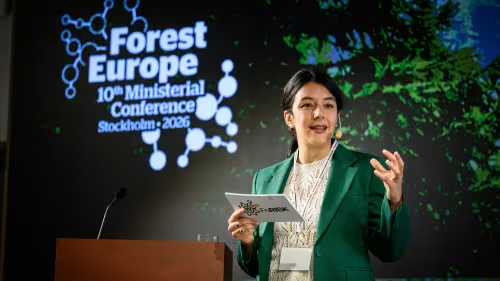
Integrated wildfire management and forest resilience take centre stage in the 10th FOREST EUROPE Ministerial Conference
FoRISK highlighted wildfire prevention, resilient forest management and cross-sector cooperation at the FOREST EUROPE 2026 Ministerial Conference.
- Resilient forests
Wildfires are Europe’s new normal: why we urgently need to act
EFI experts urge moving from managing each fire as an isolated emergency to managing fire risk across landscapes and throughout the year.
- Resilient forests
FoRISK recognised in EU Council Recommendation on Integrated Wildfire Management
FoRISK is recognised in a new EU Council Recommendation as a key initiative advancing cooperation and capacity building on forest risks.
- Resilient forests