Non-wood forest products in Europe: Seeing the forest around the trees
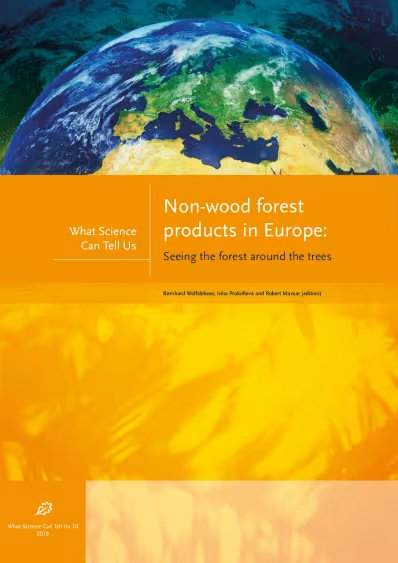
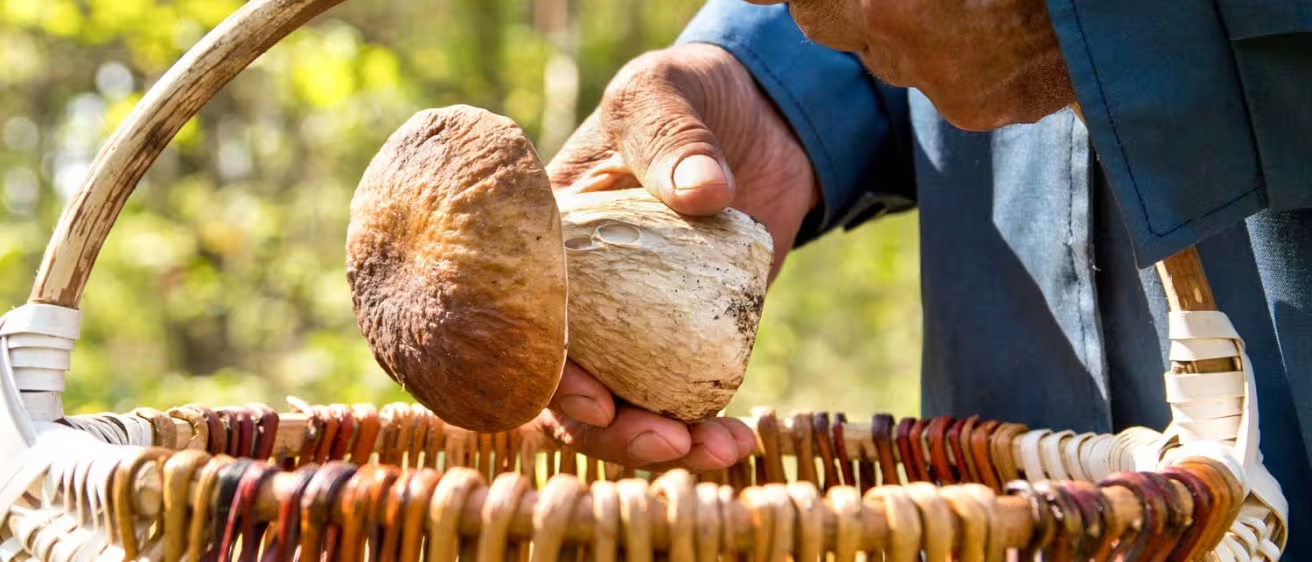
Photo by:
Stanislau_V, AdobeStock
The forest-based sector has mainly developed around wood-based products. This is due to the significant relative economic importance of wood and the well-developed and competitive value chains based on wood as a raw material (e.g. wood products, pulp and paper, bioenergy). However, there is increasing evidence that non-wood forest products (NWFPs) constitute an important and underrated segment of forest goods and services.
According to the Millennium Ecosystem Assessment, more than 150 NWFPs are of importance within international trade. The 2015 report on the State of Europe’s Forests estimated that the total value of NWFPs in the FOREST EUROPE region reached €2.28 billion, of which 73% was generated by plant products. In addition, there are significant differences in the access, utilization and economic importance of NWFPs in Europe.
The reasons for these differences are discussed in a new publication – based presents the results of the EU FP7 project “Multipurpose trees and non-wood forest products: a challenge and opportunity (StarTree). – which follows the complete value chain from primary production to marketing, and the accompanying institutional frameworks.
The publication goes into further depth: giving new insights into NWFPs in Europe; presenting new findings on markets in Europe; sketching out the needs for a new policy framework that addresses both EU and national specifications; and presenting examples of innovation in the sector.
It is important to state that NWFPs cover both the dimension of natural resources and materials, but are also strongly connected to the provision of ecosystem services, conservation issues, traditional knowledge, cultural values, and the complex of drivers in the context of rural development. These aspects have to be recognized when discussing stronger marketing and commercialization of NWFPs and the related trade-offs.
Why is this important? In a bioeconomy based on natural resources, there is a need to more fully understand the complete spectrum of resources available, to identify potentials and niches of these resources, to clarify use rights, and also trade-offs and synergies between forest and other land-use forms.
Citation
Wolfslehner, B., Prokofieva, I. and Mavsar, R. (editors). 2019. Non-wood forest products in Europe: Seeing the forest around the trees. What Science Can Tell Us 10. European Forest Institute.
Number of pages: 114
ISBN 978-952-5980-78-3 (pdf)
-
Irina Prokofieva

Related content
Seeing the wood in the forests
We need to accelerate the transition from the existing global fossil and wasteful economy towards a renewable economy: a circular bioeconomy.
- Sustainable economy
Forest Innovation Readiness
A self-assessment catalogue for innovators, start-ups, self-disrupting companies, and researchers-turned-entrepreneurs in the forest-based bioeconomy.
- Sustainable economy
ROSEWOOD4.0
ROSEWOOD4.0 harnesses digital solutions and boosts knowledge transfer to reinforce the sustainability of wood mobilisation in Europe.
- Sustainable economy