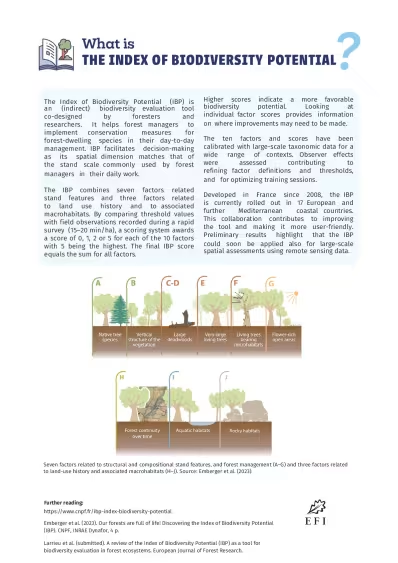
The Index of Biodiversity Potential (IBP) is an (indirect) biodiversity evaluation tool co-designed by foresters and researchers. It helps forest managers to implement conservation measures for forest-dwelling species in their day-to-day management. IBP facilitates decision-making as its spatial dimension matches that of the stand scale commonly used by forest managers in their daily work.
The IBP combines seven factors related stand features and three factors related to land use history and to associated macrohabitats. By comparing threshold values with field observations recorded during a rapid survey (15–20 min/ha), a scoring system awards a score of 0, 1, 2 or 5 for each of the 10 factors with 5 being the highest. The final IBP score equals the sum for all factors.
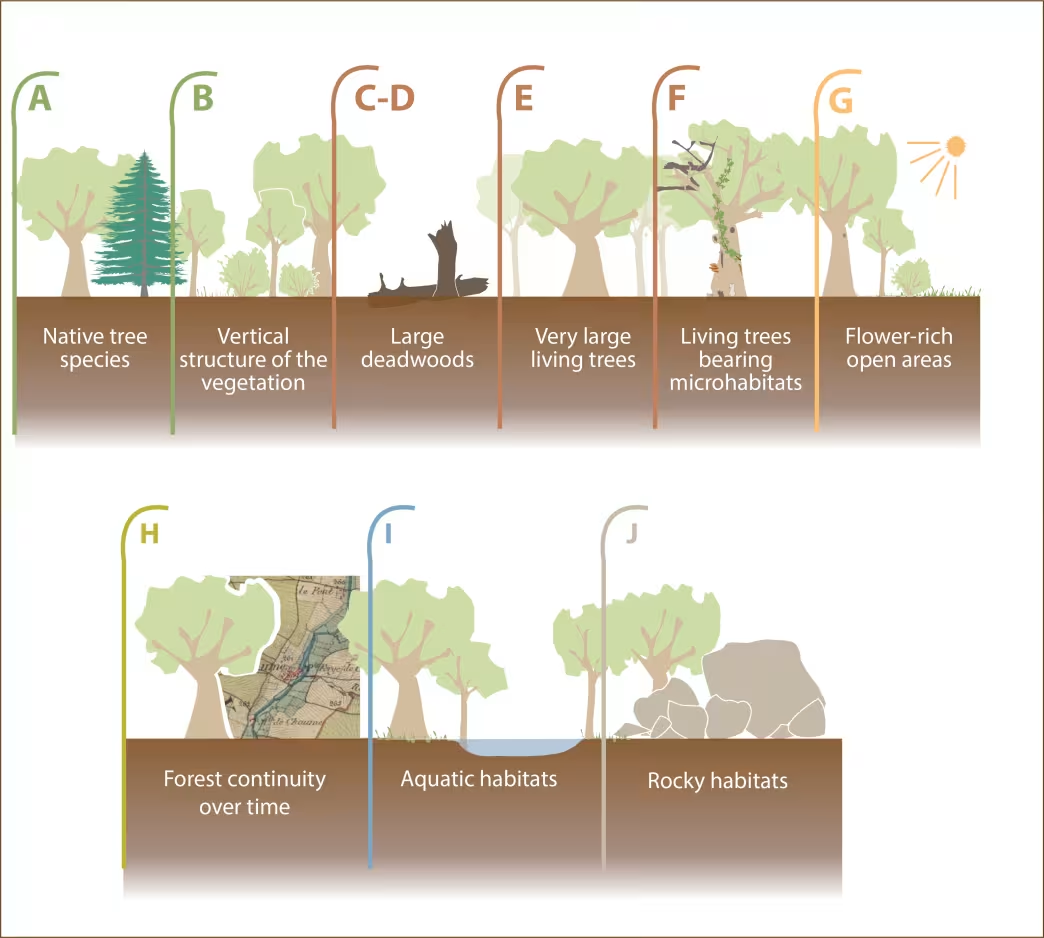
Seven factors related to structural and compositional stand features, and forest management (A–G) and three factors related to land-use history and associated macrohabitats (H–J). Source: Emberger et al. (2023).
Higher scores indicate a more favorable biodiversity potential. Looking at individual factor scores provides information on where improvements may need to be made.
The ten factors and scores have been calibrated with large-scale taxonomic data for a wide range of contexts. Observer effects were assessed contributing to refining factor definitions and thresholds, and for optimizing training sessions.
Developed in France since 2008, the IBP is currently rolled out in 17 European and further Mediterranean coastal countries. This collaboration contributes to improving the tool and making it more user-friendly. Preliminary results highlight that the IBP could soon be applied also for large-scale spatial assessments using remote sensing data.
Further reading:
https://www.cnpf.fr/ibp-index-biodiversity-potential
Emberger et al. (2023). Our forests are full of life! Discovering the Index of Biodiversity Potential (IBP). CNPF, INRAE Dynafor, 4 p.
Larrieu et al. (submitted). A review of the Index of Biodiversity Potential (IBP) as a tool for biodiversity evaluation in forest ecosystems. European Journal of Forest Research.
-
Laurent Larrieu


Related content
- Co-created solutions

What is a marteloscope?
Marteloscopes are used to perform (virtual) tree selection exercises and help to compare alternative forest management strategies.
- Co-created solutions
What is forest biodiversity?
Forest biodiversity includes not only species diversity, but also the variety of functions they perform, from genes to landscapes.
- Resilient forests