Social innovation refers to rethinking and reshaping social practices to improve society’s well-being in response to different challenges. It aims at enhancing collective well-being and system change. This process often involves civil society and focuses on transforming traditional ways of addressing poverty, environmental degradation, or social inequality. It can result in the development of new collaborations between the public, private, and civil sectors. Social innovations can emerge at any level – from the local level (e.g. grassroots initiatives) to national ones (e.g. in forest policies).
In forestry, social innovation plays a key role in empowering the local population, fostering economic development, and promoting sustainable resource management. It has the potential to revitalise rural areas by addressing structural challenges such as depopulation and marginalisation, while encouraging new management forms and uses for forest-based resources (e.g. community forestry, ecotourism).
The implementation of social innovation remains challenging. Gaps in policies, governance structures and institutions can impede the progress of social innovations. Overcoming these requires building trusted networks, supporting local leadership, and creating flexible policy frameworks that allow social innovations to thrive.
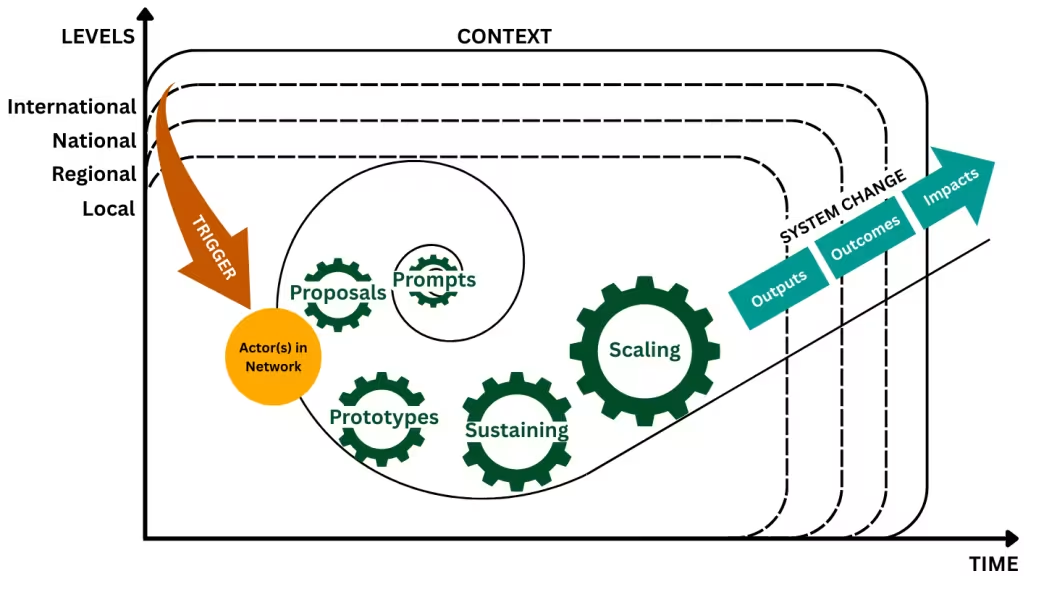
The social innovation process is represented as being shaped by key dimensions, which include the context, actors, and trigger. Social innovation is further exercised through its components, which are the levels, time, and iterative stages including prompts, proposals, prototypes, sustaining, and scaling. These lead to outputs, outcomes, and impacts that drive systemic change. Graph based on Rogelja et al. 2023; Murray 2011.
Further reading
Živojinović et al. 2023. Institutional structures impeding forest-based social innovation in Serbia and Slovenia. Forest Policy and Economics, 151, 102971. https://doi.org/10.1016/j.forpol.2023.102971

Related content
What role do forests play in the EU Nature Restoration Regulation?
Insights into the EU Nature Restoration Regulation
- Inclusive governance
EFI Scientific Seminar 2026: Forest Frontlines: From Conflicts to Diplomacy
The seminar moved from understanding of forest conflicts to exploring tools and mindsets for conflict transformation and forest diplomacy.
- Inclusive governance
Advancing jurisdictional sustainability in the Central Highlands region of Viet Nam
Developing a jurisdictional sustainability framework and an associated monitoring system in Viet Nam to promote sustainable land use and coffee…
- Inclusive governance