Photo by:
Vivaan Trivedii
Publication series
From Science to Policy
Robust, relevant, and timely knowledge combined with scientific analysis providing evidence-based information to support policy action.

EFI Policy Briefs
Concise analysis of key issues and policy implications, translating scientific evidence into actionable pathways.

Knowledge to Action
Visually rich, with graphics and examples, bringing a wide range of research, projects and initiatives on forest-related issues closer to society.

What Science Can Tell Us
Collective scientific expert reviews providing interdisciplinary background information on key and complex forest-related issues.

All publications
Annual Report 2025
Explore EFI's 2025 achievements, impact, partnerships, and key milestones shaping forests, sustainability, and society.

Interdisciplinary insights on climate-smart rewilding
Lessons from 30 years of rewilding show how adaptive thinking, policy support and partnerships can drive climate resilience and biodiversity.
- Resilient forests
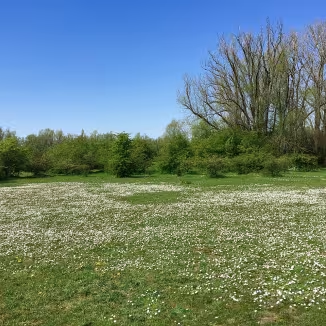
Forest Innovation Readiness
A self-assessment catalogue for innovators, start-ups, self-disrupting companies, and researchers-turned-entrepreneurs in the forest-based bioeconomy.
- Sustainable economy

Guide de bonnes pratiques sylvicoles
Ce guide est décliné sous forme de fiches techniques dédiées aux divers peuplements forestiers rencontrés sur le terrain.
- Resilient forests
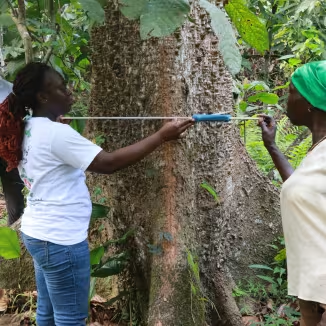
Healthy Cities by Nature: How urban nature can become public health infrastructure
This brief examines how urban green spaces protect public health and how cities can embed nature into everyday planning, services, and education.
- Cities

Overview of some commonly used mobile apps for collecting geolocation information
An overview of key features, accessibility and usability of six commonly used free tools for collecting plot-level geolocation information.
- Forests and people

Know your plot: the importance of geolocation for farmers
Why farmers should know the exact geolocation of their plots, and how this data can be collected.
- Forests and people
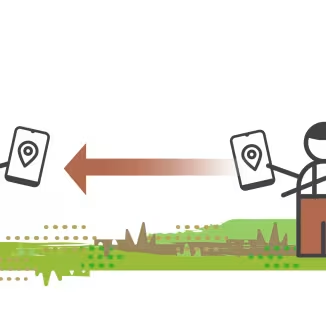
Geolocating plots of land
A guide for cooperatives and other actors on supporting the collection of geolocation information of farmers – covering why, how, and data ownership.
- Forests and people
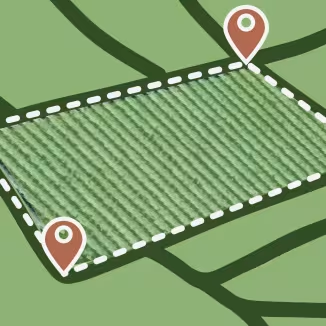
Farmer-managed natural regeneration: Helping trees regrow naturally on your land
This infographic outlines the steps farmers can take to help naturally regrowing trees on their lands to survive and thrive.
- Forests and people

Dynamic and static ex situ conservation: minimum requirements, data standards and indicators for monitoring
EUFORGEN report clarifies terminology, sets minimum requirements and standards, and guides dynamic ex situ FGR conservation.
- Resilient forests