Integrated Fire Management essential for a fire-resilient Europe, advises new EFI Policy Brief
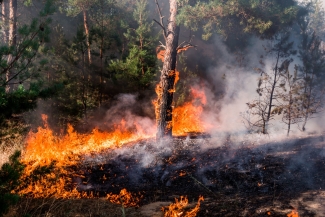
The European Forest Institute (EFI) has published a new Policy Brief, Integrated Fire Management – empowering action for a fire-resilient Europe, calling for a decisive shift in how Europe prepares for and responds to the growing threat of extreme wildfires.
In 2025, burnt areas across the European Union exceeded 1 million hectares—more than double the area impacted in 2024 and the highest level recorded since monitoring began in 2006. Climate change, land abandonment, and increasing fuel loads are extending the fire season and intensifying wildfire behaviour, including in regions historically considered low risk. Furthermore, Europe risks remaining trapped in a cycle of reactive wildfire suppression, which can unintentionally increase long-term risk by allowing fuels to accumulate.
The Policy Brief urges that preventing future catastrophic events requires a fundamental shift toward Integrated Fire Management—an approach that links wildfire ecology, management, and governance.
Integrated Fire Management is a framework that understands wildfire as a natural ecological process and a societal challenge, rather than simply an emergency. Prevention and suppression are considered alongside the ecological role of fire, as well as socio-economic and cultural factors. Building societal resilience is central to the approach and requires strengthening public awareness and bottom-up engagement, while nature-based solutions can offer support in managing wildfires.
The Policy Brief calls for coordinated action at European, national, and regional levels to ensure policies reflect the realities of changing fire regimes. It provides 14 key recommendations for consideration by policymakers, ranging from governance and funding mechanisms, conservation planning, and capacity building, to measures for proactive fire prevention, community engagement, and public awareness raising. It also calls for investment in post-fire recovery, including the use of climate-smart forestry and rural development as part of the wildfire resilience agenda.
Read the full Policy Brief: https://doi.org/10.36333/pb19
Photo: yelantsevv / AdobeStock