Forest damage in Europe could double by 2100, major study warns
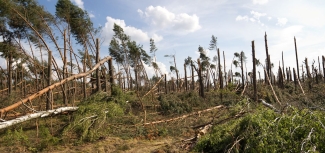
A new study with EFI contribution, published in Science, warns that climate-driven disturbances such as wildfires, storms, and bark beetle outbreaks could dramatically reshape Europe’s forests over the coming decades – with damaged forest area potentially doubling by 2100 in the worst-case scenario.
Research in the publication “Climate change will increase forest disturbances in Europe throughout the 21st century”, led by scientists at the Technical University of Munich, is among the first to quantify how much of Europe’s forests could be affected under different climate pathways. The paper was published as part of the RESONATE project, coordinated by Marcus Lindner, who also contributed to the study, together with Mats Nieberg (both EFI).
Using a combination of multi-decadal satellite observations and advanced forest simulations across roughly 13,000 locations, researchers trained an AI-based model on around 135 million data points to project how disturbances may evolve through the 21st century. Their findings show that future disturbance levels exceed those observed today in all scenarios, with significant implications for carbon storage, biodiversity, and timber supply.
“Tree mortality is a natural part of forest dynamics,” says lead researcher Rupert Seidl, professor of Ecosystem Dynamics and Forest Management at TUM. “What is new is the scale at which climate change is amplifying disturbances.”
The study used data from 1986 to 2020 – already a period of unusually high disturbance – as a baseline. Even if global warming is limited to around 2°C, the researchers project a notable increase in forest damage compared with this reference period. Under a scenario with warming exceeding 4°C, the area affected by fires, storms, and bark beetles could more than double.
Regional differences are pronounced. Forests in Southern and Western Europe are expected to face the strongest increases in disturbance, while Northern Europe may experience less severe impacts overall, albeit with emerging hotspots. The researchers note that disturbances are increasingly a cross-regional issue, with the potential to disrupt timber markets and affect the ecosystem services forests provide.
Marcus Lindner argues: “This study provides a big step forward by integrating disturbance interactions and vegetation feedback in one simulation framework, creating more robust disturbance scenarios for the future. The results emphasise the need for rapid GHG emission reductions to prevent worst case climate change impacts with much more extreme disturbance increases.”
The findings highlight the urgent need for policymakers and forest managers to prepare for greater volatility, and have been distilled into an EFI Policy Brief, The future of European forest disturbance regimes, with clear recommendations for action now.
Yet while increased disturbances can reduce carbon sequestration and alter habitats, they can also create opportunities to establish more climate-resilient forests. The authors argue that adapting forest management strategies – from diversifying tree species to planning for disturbance recovery – will be critical. By integrating new scientific tools and collaborative efforts such as the RESONATE project, they say Europe can better navigate the risks while harnessing opportunities for transformation.
The study and the related policy brief underscore a clear message: as the climate warms, proactive action will be essential to safeguard Europe’s forests and the benefits they provide to society.
Publication:
Scientific paper: Grünig, M.; Rammer, W.; Senf, C. et al: Climate change will increase forest disturbances in Europe throughout the 21st century, Science 2026, https://doi.org/10.1126/science.adx6329
Policy brief: Seidl, R., Grünig, M., Rammer, W. and Lindner, M. 2026. The future of European forest disturbance regimes. EFI Policy Brief 20. European Forest Institute. https://doi.org/10.36333/pb20
Photo: schab / AdobeStock