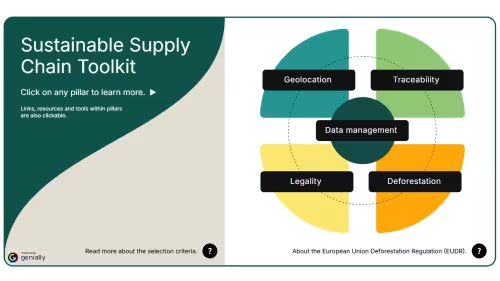
Not an easy ride
Economic research priorities for pro-environmental trade regulationAbstract
Demand-side trade regulation is promoted as a policy tool to reduce negative environmental and socioeconomic footprints associated with global commodity supply chains. We present a theory of change (ToC) that explains how the economics of pro-environmental trade regulation can be expected to work, using the recent EU Regulation on Deforestation-free products (EUDR) as a topical illustration. Along this complex ToC, we review and characterize multiple factors that might either constrain overall policy effectiveness or enhance it. Evidence suggests that, in addition to land-use leakage (the displacement of environmental pressures to unregulated domains), predictably strong market-segregating responses might rearrange sourcing and trading patterns, especially where EU commodity import shares are low. Lacking observable and attributable land-use changes, segregation spillovers are harder to document. We outline an economically informed interdisciplinary research agenda around the potential impact pathways of demand-side trade regulations. However, our ex-ante conceptual policy assessment also cautions of potential functional shortcomings in reaching the desired global forest-protective goals.
Citation
Dario Schulz, Johanna Coenen, Mairon Bastos Lima, Laila Berning, Jan Börner, Mathias Cramm, Cecilia Fraccaroli, Gustavo Magalhães de Oliveira, U. Martin Persson, Metodi Sotirov, Sven Wunder, Not an easy ride: Economic research priorities for pro-environmental trade regulation, Forest Policy and Economics, 182, 2026, 103682, https://doi.org/10.1016/j.forpol.2025.103682




Related content
Traded goods also need check-in luggage, for their data!
A practical look at how origin data can move with agricultural commodities through complex supply chains.
- Inclusive governance
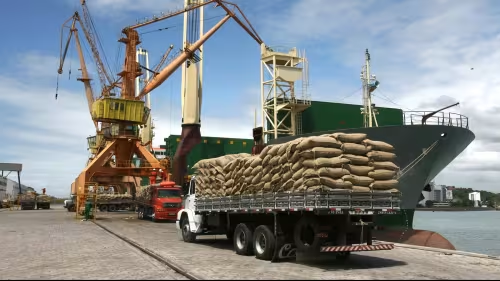
¿Qué herramientas existen para cumplir con el EUDR?
Descubra qué herramientas gratuitas y de código abierto están disponibles para los actores de la cadena de suministro ante el EUDR.
- Sustainable economy
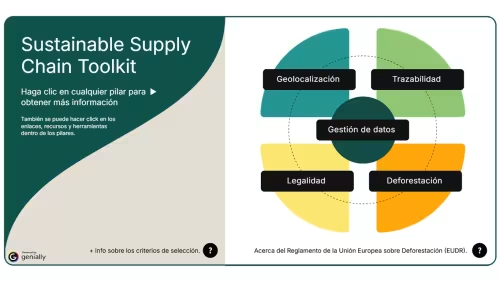
What tools are available to comply with the EUDR?
Discover what free and/or open-source tools are available to supply chain actors to comply with the EU Deforestation Regulation.
- Sustainable economy